
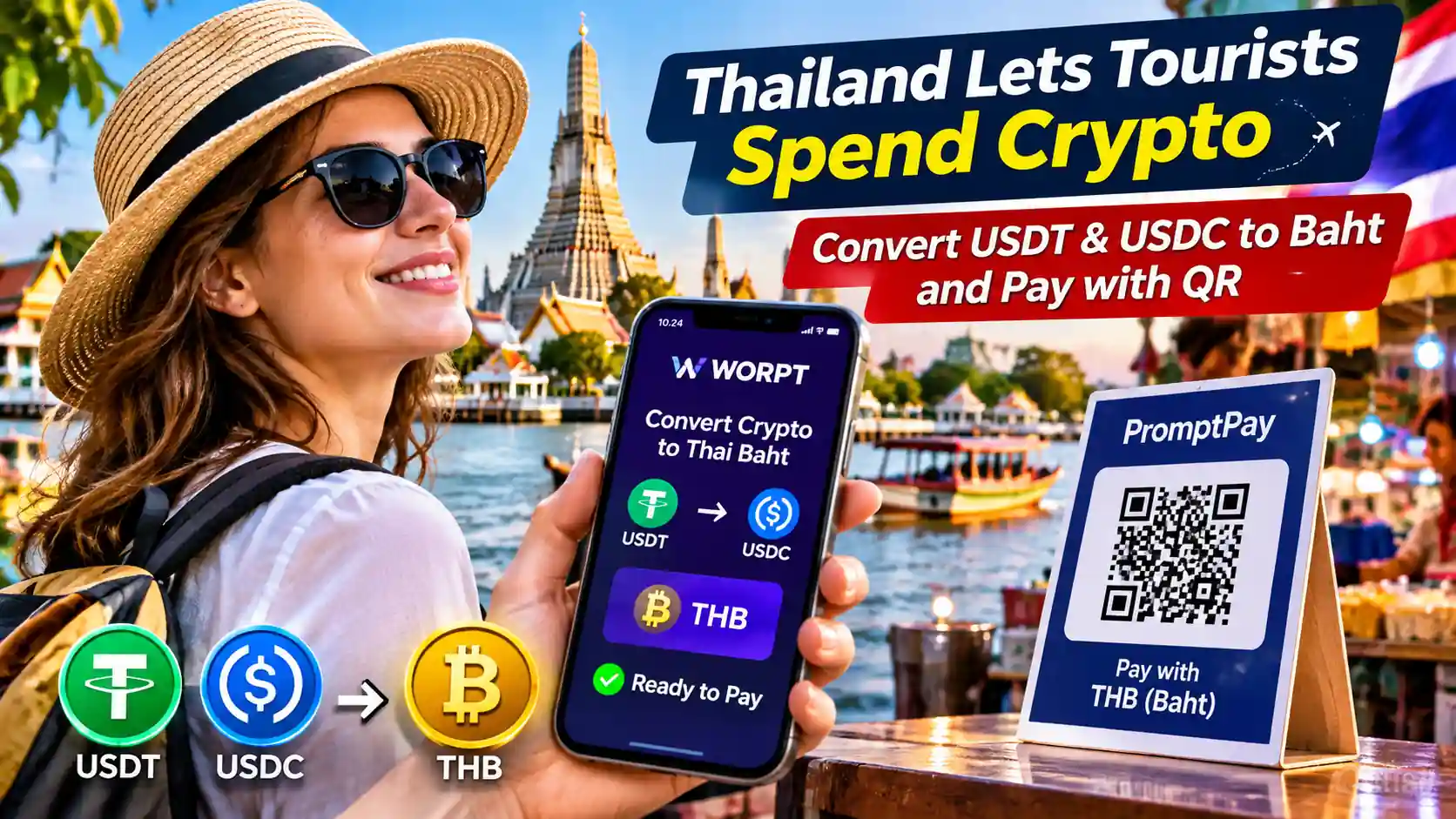
Thailand is exploring a new way to make digital payments easier for international visitors. Through the WORPT app, eligible tourists can convert supported cryptocurrencies into Thai baht and use the local QR payment system to pay participating merchants.
The initiative is part of Thailand’s TouristDigiPay regulatory sandbox, which aims to connect digital assets with the country’s existing electronic payment infrastructure.
For travellers who already hold stablecoins such as USDT or USDC, the service could offer another way to access spending money during a visit to Thailand. However, it comes with eligibility requirements, transaction limits and conversion fees.
Here are five important things tourists should know about Thailand Crypto Payments for Tourists and how the WORPT app works.
1. What Is WORPT and How Does It Work?
WORPT is a payment application designed to help eligible foreign tourists convert supported digital assets into Thai baht.
The service connects cryptocurrency conversion with an electronic money balance. Once the supported digital assets have been converted, users can spend the baht balance at participating merchants through Thailand’s QR payment infrastructure.
This is different from paying a shop directly in Bitcoin, USDT or another cryptocurrency. The merchant receives Thai baht rather than cryptocurrency.
The service was introduced under Thailand’s TouristDigiPay regulatory sandbox, which is intended to test regulated ways of using digital assets for tourism-related payments.
2. Which Cryptocurrencies Can Tourists Use?
The WORPT service information identifies two supported stablecoins:
- USDT (Tether): A stablecoin designed to maintain a value linked to the US dollar.
- USDC (USD Coin): A dollar-linked stablecoin issued by Circle.
The service information specifies the Ethereum network using the ERC-20 standard for these supported assets.
This network requirement is important. Sending tokens through an unsupported blockchain or to an incorrect wallet address can result in lost funds. Tourists should always check the supported network and wallet instructions inside the official app before making a transfer.
Stablecoins are not risk-free. Their value, availability and redemption can be affected by issuer, platform, liquidity and regulatory risks.
3. How Can Tourists Pay Using QR Codes?
After completing the required registration and conversion process, eligible users can use their Thai baht balance to make payments at participating merchants.
The general process is:
- Register with the WORPT service and complete identity verification.
- Connect an eligible cryptocurrency wallet.
- Transfer supported USDT or USDC using the specified network.
- Convert the digital assets into Thai baht.
- Scan a participating merchant’s QR code and pay using the available baht balance.
The advantage is that tourists do not need to ask merchants to accept cryptocurrency directly. Payments are made in Thai baht through the local payment system.
However, the service should not be confused with universal QR acceptance. Not every shop or merchant is necessarily supported.
4. What Are the Fees and Transaction Limits?
Cost is an important consideration before using any payment service.
According to WORPT’s published service information, the cryptocurrency conversion fee is 1.5%, including VAT.
The published service limits include:
- Maximum e-money balance: 100,000 Thai baht.
- Maximum single transaction: 100,000 Thai baht.
- Monthly top-up limit: 500,000 Thai baht.
Additional restrictions can apply depending on the type of merchant and transaction. Fees, limits and service conditions may also change.
Tourists should review the latest terms in the official app before transferring cryptocurrency. They should also consider any network fees charged by the wallet or blockchain service they use.
5. Who Can Use WORPT in Thailand?
WORPT is intended for eligible foreign visitors, not automatically for every traveller.
The published registration requirements include a valid passport with an NFC chip and identity verification using facial recognition.
Users must complete the service provider’s checks and satisfy the applicable regulatory requirements. Approval is not guaranteed simply because someone holds USDT or USDC.
The service is also subject to Thailand’s regulatory framework and the conditions of the TouristDigiPay sandbox.
Travellers should confirm their eligibility, supported wallet, payment locations and account limits before depending on WORPT for travel expenses.
Is WORPT a Sign That Thailand Now Accepts Cryptocurrency Everywhere?
No. This distinction is essential.
Thailand’s TouristDigiPay initiative provides a regulated route for eligible visitors to convert supported digital assets into Thai baht. Participating merchants receive baht through the payment system.
It does not mean that all Thai businesses accept cryptocurrency directly, or that tourists can use any digital asset at every shop.
WORPT’s service is also subject to its own registration, conversion, payment and transaction conditions.
What Could This Mean for the Future of Travel Payments?
Thailand’s approach shows how digital assets could connect with traditional payment infrastructure without requiring merchants to handle cryptocurrency themselves.
For tourists, this may create another option for accessing local spending money. For businesses, it could make it easier to serve visitors who hold digital assets while continuing to receive payments in the local currency.
The longer-term success of the initiative will depend on user adoption, merchant participation, service reliability and regulatory developments.
WORPT has also discussed Visa prepaid card services as a future addition. These should be treated as planned features unless their actual availability is confirmed through an official announcement.
Final Thoughts
Thailand Crypto Payments for Tourists represent an interesting development in the relationship between cryptocurrency and international travel.
WORPT brings supported stablecoins, Thai baht conversion and QR payments into one service for eligible visitors. Its published conversion fee, network requirements and account limits are important details to understand before using it.
The initiative is worth watching, but travellers should check the latest official terms and never transfer funds without verifying the wallet address and supported network.
Disclaimer: This article is for informational purposes only and is not financial or investment advice. Cryptocurrency transactions involve risks, and service availability, fees and regulatory conditions may change.