
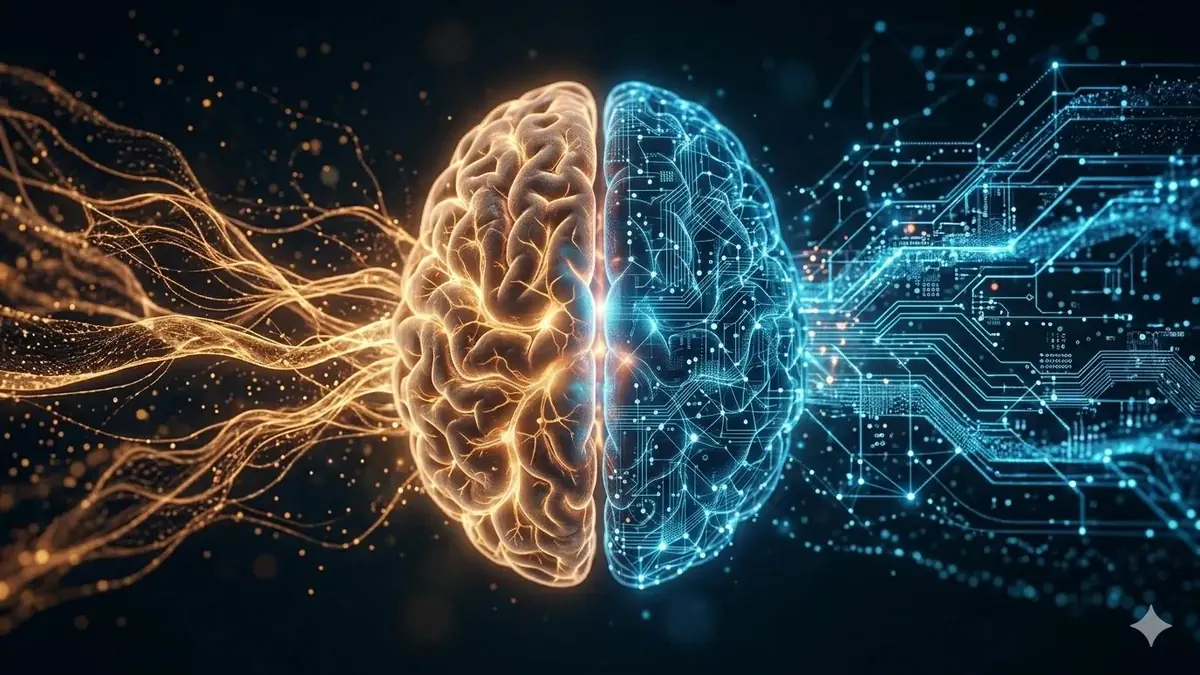
Artificial intelligence is no longer just a tool for answering questions or performing calculations. It can write, create images, analyse information, assist with medical decisions, generate computer code, and increasingly influence how people work, learn and communicate.
Can AI take over the human mind? This question is becoming increasingly important as artificial intelligence advances and begins to influence how people think, learn, make decisions and interact with the world.
The answer depends on what we mean by “take over.”
AI is not currently known to possess human-like consciousness, emotions or subjective experience. However, it can already influence human decisions and change how people process information and perform cognitive tasks that were traditionally handled by the human brain.
The real concern may not be that AI suddenly becomes a human mind. It may be that humans gradually become too dependent on artificial intelligence to think independently.
Research in psychology, neuroscience and AI safety provides important clues about this possibility.
1. What Does It Mean for AI to Take Over the Human Mind?
There are at least four different ways to understand this question.
Cognitive takeover: People increasingly depend on AI for remembering, analysing, writing, problem-solving and making decisions.
Psychological influence: AI systems influence what people believe, prefer, purchase and choose through personalised recommendations and conversational interactions.
Loss of human autonomy: People begin accepting AI-generated answers without questioning them, gradually weakening their independent judgement in certain tasks.
Consciousness or mind transfer: The more speculative possibility that human consciousness could one day be replicated or transferred into a digital system.
These possibilities are not equally developed. The first three already have real-world research and evidence behind them. The fourth remains a major scientific and philosophical challenge.
2. Can AI Think Better Than the Human Brain?
AI systems can outperform humans in particular tasks, including large-scale data analysis, pattern recognition, mathematical calculations and processing enormous amounts of information.
However, intelligence is not a single ability.
The human mind combines memory, emotions, physical experience, social understanding, creativity, self-awareness and the ability to make decisions under uncertain conditions.
AI systems can simulate many aspects of human reasoning, but their capabilities and limitations are different.
A 2026 review published in Annual Review of Psychology, by researchers Michael C. Frank and Noah D. Goodman, discusses how AI models can help scientists understand human cognition. It also highlights the importance of carefully evaluating how artificial models relate to actual human mental processes.
The important distinction is this: performing an intelligent task does not automatically mean possessing a human mind.
3. The Hidden Risk: Humans May Stop Thinking Independently
One of the most important concerns is cognitive dependence.
Imagine a student who uses AI to answer every question without attempting to understand the subject.
A professional who asks AI to prepare every report without checking the information.
Or a person who asks an AI assistant to make every important financial or personal decision.
These people may become more productive in the short term. But if they stop practising essential skills, their independent abilities may weaken.
A 2025 study involving 319 knowledge workers, published in the Proceedings of the ACM CHI Conference, examined the relationship between generative AI confidence and critical-thinking engagement.
The researchers found that higher confidence in generative AI was associated with less reported critical-thinking effort during AI-assisted work.
This finding does not prove that AI permanently damages human intelligence. It does, however, raise an important question about what happens when people repeatedly outsource their thinking.
The American Psychological Association also reviewed emerging research in July 2026. Its report highlighted that passive dependence on AI may weaken certain skills, while deliberate and structured AI use can support human performance.
The lesson: AI can become a thinking partner, but it should not become a replacement for thinking.
4. Automation Bias: Why Humans May Trust AI Too Much
Automation bias occurs when people give excessive importance to information supplied by an automated system, even when that information is incorrect.
For example:
- A doctor may overlook evidence that contradicts an AI-generated recommendation.
- A financial user may follow an AI-generated investment explanation without verifying the figures.
- A student may accept an incorrect AI answer because it sounds confident.
- A manager may approve an AI-generated report without checking its sources.
The International AI Safety Report 2026 describes this problem as a concern for human autonomy.
It also discusses a randomised experiment involving 2,784 participants performing an AI-assisted annotation task. Participants were less likely to correct erroneous AI suggestions when correction required extra effort or when they already had favourable attitudes towards AI.
This illustrates a serious weakness in human-machine interaction: people may gradually trust convenience more than independent verification.
5. Can AI Influence Human Emotions and Beliefs?
AI systems are increasingly capable of holding natural conversations, adapting their responses and generating personalised content.
Some applications are designed specifically to provide companionship and emotionally engaging interactions.
This creates opportunities as well as risks.
AI can help people organise their thoughts, practise communication and access information. However, emotionally responsive systems may also encourage excessive dependence or influence people’s beliefs and preferences.
The International AI Safety Report 2026 notes that AI companion applications have grown rapidly. It also explains that evidence about their psychological effects remains early-stage and mixed.
Some studies have reported patterns involving loneliness and reduced social interaction among frequent users, but stronger long-term research is still needed.
What Yuval Noah Harari Warns About
Historian and author Yuval Noah Harari, best known for Sapiens and Homo Deus, has raised concerns about AI’s ability to influence human relationships, trust and decision-making.
In an August 2026 interview with The Economist, Harari described AI as a major psychological and social experiment. He discussed how machines could become more trusted than humans and how AI companions might use personal knowledge and conversational abilities to create convincing emotional relationships.
His concern is particularly relevant to the human mind: an AI system that understands someone’s interests, fears and personal history could potentially influence that person’s beliefs and choices.
Harari also warned that AI could be used by malicious actors to manipulate people and public debate. However, he did not describe such an outcome as inevitable. Human decisions, public accountability and safeguards can influence the direction of AI development.
This raises an important question: if people begin trusting an AI system more than their own judgement or the people around them, how much influence could that system eventually gain?
The central issue is not whether every AI conversation is harmful. It is whether users remain aware that they are interacting with a system designed to generate responses, rather than a human relationship.
6. Could AI Become Conscious?
This is perhaps the most fascinating part of the debate.
Consciousness is generally understood as subjective experience: the ability to experience something from a first-person perspective.
Humans do not simply process information. We experience pain, happiness, fear, memories and sensations.
Current AI systems can produce convincing language about emotions, but convincing descriptions are not proof that a system actually experiences those emotions.
What Anil Seth, Ned Block and Giulio Tononi Argue
In an October 2026 commentary published in Nature, neuroscientist Anil K. Seth, philosopher Ned Block and neuroscientist Giulio Tononi argued that intelligence alone is insufficient to establish consciousness.
Their article, Three Reasons Why AI Is Not Conscious and Perhaps Never Will Be, explains why the ability to perform intelligent tasks should not be confused with the ability to have subjective experiences.
They argue that language models can imitate human expressions of thought and feeling without necessarily experiencing anything themselves. Their position is that existing AI systems are not conscious and, under current approaches to development, are unlikely to become conscious.
David Chalmers: Could Future AI Become Conscious?
Philosopher David Chalmers offers a perspective that leaves more room for future possibilities.
In a July 2026 discussion at the University of California, Berkeley, Chalmers said he was inclined to treat present-day AI systems as tools rather than conscious beings. However, he also acknowledged that future systems could raise much harder questions about consciousness and moral status.
His position highlights an important uncertainty: scientists still do not have a complete explanation of human consciousness, making it difficult to establish exactly what would prove that a machine has subjective experience.
These different perspectives show why the subject remains controversial. Some researchers are strongly sceptical about conscious AI, while others believe future developments should not be ruled out.
There is still no universally accepted scientific test that can conclusively establish whether an AI system has subjective experience.
Therefore, it would be incorrect to claim that today’s conversational AI systems are conscious simply because they can discuss emotions or describe themselves.
7. Could Humans Eventually Upload Their Minds Into Computers?
The idea of mind uploading has fascinated scientists and science-fiction writers for decades.
The theoretical concept is known as whole-brain emulation.
In principle, researchers would need to understand and reproduce the relevant structure and functioning of an individual human brain in a computational environment.
But the challenges are enormous.
The brain contains tens of billions of neurons and an extraordinary number of connections. Scientists still do not fully understand how its complex circuits interact to produce memory, identity, emotions and consciousness.
In September 2026, researchers at MIT’s McGovern Institute examined the scientific and philosophical challenges of consciousness uploading.
Their discussion highlighted that scientists do not yet know precisely what level of brain mapping and biological detail would be necessary to reproduce a person’s mind.
Even if a digital system could reproduce someone’s memories and behaviour, an unresolved question would remain:
Would that digital copy actually be the same conscious person, or simply a sophisticated imitation?
At present, mind uploading remains hypothetical rather than an available scientific technology.
8. What Happens If Humans Become Too Dependent on AI?
The biggest near-term risk may be gradual rather than dramatic.
Consider how people already use technology.
Calculators reduce the need for mental arithmetic. GPS navigation reduces the need to remember routes. Search engines make information easier to retrieve.
AI takes this dependence to another level because it can help perform tasks involving language, reasoning, planning and judgement.
If people stop practising these abilities, certain skills may become weaker through lack of use.
The International AI Safety Report 2026 also discusses evidence that AI exposure can affect professional skills. It cites a clinical study in which clinicians’ ability to detect tumours without AI was approximately 6% lower following several months of exposure to AI-assisted diagnosis.
This is an important example, but it should not be interpreted as proof that AI universally reduces intelligence. It demonstrates why human skills and independent performance must continue to be evaluated when AI becomes part of professional work.
9. How Can Humans Protect Their Independent Thinking?
The solution is not to reject artificial intelligence.
Instead, people need to learn how to use AI without surrendering their judgement.
Here are seven practical principles:
1. Think before asking AI
Try to solve a problem independently before requesting an AI-generated answer.
2. Verify important information
Check financial, medical, legal and professional information against reliable sources.
3. Keep learning without AI
Read books, practise writing, solve problems and develop knowledge independently.
4. Use AI to challenge your ideas
Ask AI to identify weaknesses in your reasoning rather than simply agreeing with you.
5. Make your own important decisions
AI can explain options, but personal values, responsibilities and circumstances must remain central.
6. Maintain real human relationships
Technology should support communication, not replace meaningful relationships.
7. Protect your privacy
Avoid sharing highly sensitive personal information with AI systems unless you understand how the information may be handled.
10. The Future: Human Intelligence or Artificial Intelligence?
The future is unlikely to be a simple competition between humans and machines.
AI can increase productivity, support scientific discoveries, assist doctors, improve education and make complex information more accessible.
But these advantages depend on how people design, regulate and use the technology.
The International AI Safety Report 2026 warns that future loss-of-control risks remain uncertain and that current evidence is insufficient to reliably determine how today’s capabilities will scale.
It also identifies human autonomy, manipulation, cognitive dependence and the ability to maintain meaningful control as important issues.
The Bigger Warning from Leading Thinkers
Harari’s warning about AI gaining influence over trust and human relationships points towards a social challenge: people may hand over more decision-making authority to systems they increasingly rely upon.
On the other hand, the arguments of Seth, Block and Tononi remind us that intelligence and consciousness are not interchangeable. A machine does not need to be conscious to influence society, and becoming more intelligent does not automatically make it a human-like mind.
David Chalmers adds another dimension by asking how society should respond if future AI systems eventually raise credible questions about consciousness and moral status.
Together, these viewpoints suggest that the future AI debate is not just about computing power. It is also about psychology, human rights, philosophy, public responsibility and the preservation of human autonomy.
The challenge is therefore not simply to build more intelligent machines. It is to ensure that increasingly capable systems remain beneficial to the people who use them.
Final Verdict: AI May Not Take Over Our Minds, But We Could Hand Over Too Much Control
AI does not currently have demonstrated human-like consciousness, and there is no scientific evidence that it has taken control of the human mind.
However, it already has the ability to influence decisions, change work habits and perform cognitive tasks that people once handled independently.
The greatest immediate danger may not be an intelligent machine suddenly controlling humanity.
It may be a future in which people become so comfortable relying on AI that they gradually stop questioning its answers, practising their abilities and making independent decisions.
The future should not be about choosing between human intelligence and artificial intelligence. It should be about using artificial intelligence to strengthen human intelligence.
Machines may become better at processing information. But humans must remain responsible for deciding what information means, what matters and what should be done.
Because the most important question is not whether AI can think like us.
It is whether we will continue thinking for ourselves.
https://techandwealth.com/ai-tools-saas/
Research Sources and Further Reading
- International AI Safety Report 2026 — Evidence on human autonomy, cognitive skills, automation bias, AI companions and loss-of-control uncertainty.
https://internationalaisafetyreport.org/publication/international-ai-safety-report-2026 - American Psychological Association (July 2026) — How AI is reshaping human skills and thinking.
https://www.apa.org/monitor/2026/07-08/ai-job-skills-thinking - Nature (19 October 2026) — Anil K. Seth, Ned Block and Giulio Tononi, Three Reasons Why AI Is Not Conscious and Perhaps Never Will Be.
https://www.nature.com/articles/d41586-026-03313-7 - MIT McGovern Institute (September 2026) — Can and should consciousness be uploaded to a machine?
https://mcgovern.mit.edu/2026/09/02/can-and-should-consciousness-be-uploaded-to-a-machine/ - Frank and Goodman, Annual Review of Psychology (2026) — Cognitive Modeling Using Artificial Intelligence.
https://doi.org/10.1146/annurev-psych-030625-040748 - UNESCO — Ethics of Neurotechnology, including mental privacy, cognitive liberty and human autonomy.
https://www.unesco.org/en/ethics-neurotech - The Economist (August 2026) — Full-length interview with Yuval Noah Harari on AI, trust, relationships and human control.
https://www.youtube.com/watch?v=FNZhxTtOL-I - University of California, Berkeley (July 2026) — David Chalmers discusses how humans should interact with AI and the possibility of future machine consciousness.
https://news.berkeley.edu/2026/07/10/berkeley-talks-when-we-talk-to-ai-what-are-we-talking-to/
Research and editorial note: This article distinguishes observed findings, early-stage evidence, expert opinions and hypothetical future possibilities. It does not claim that AI consciousness or human mind uploading has been scientifically demonstrated.