
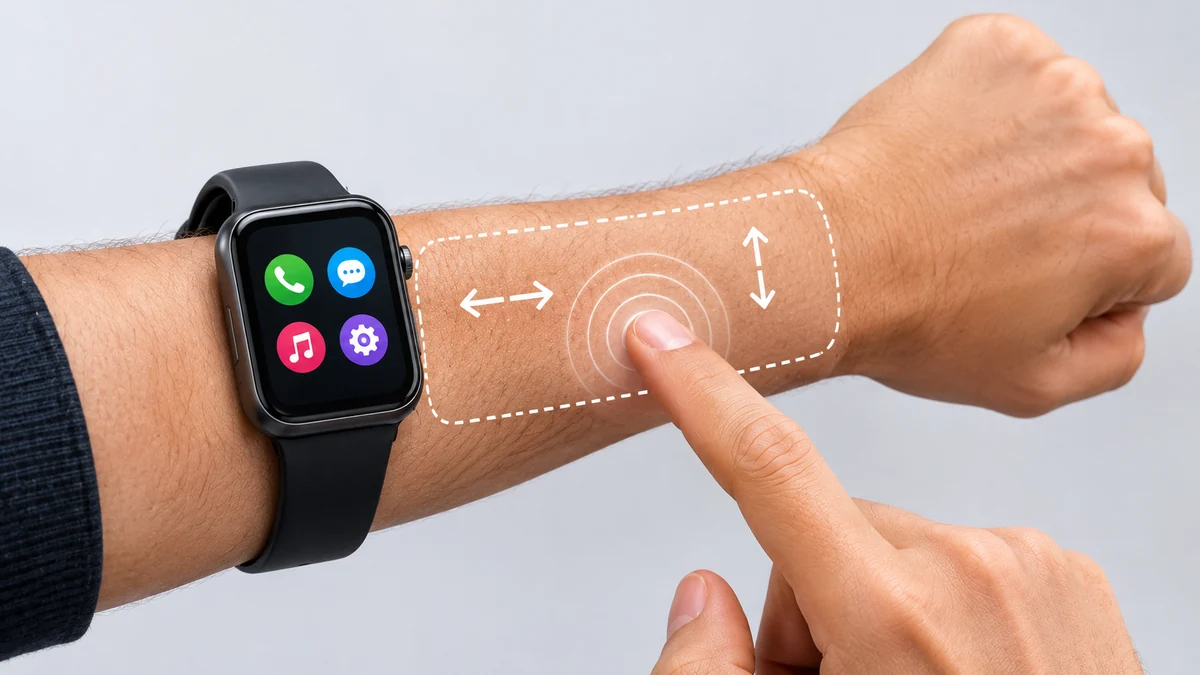
Imagine controlling your smartwatch by simply touching your forearm instead of tapping its tiny screen. This may sound futuristic, but researchers at North Carolina State University have developed a wearable technology called EpiPad Smartwatch Trackpad that aims to make this possible.
EpiPad transforms the skin surface next to a smartwatch into an interactive touchpad. Users can perform gestures such as tapping, sliding, scrolling, zooming and applying different levels of pressure.
This innovation could change how people interact with smartwatches and other compact wearable devices.
What Is EpiPad Smartwatch Trackpad Technology?
EpiPad is an experimental wearable input system developed by researchers at North Carolina State University (NC State).
The technology uses a compact millimeter-wave (mmWave) radar sensor mounted on a wristband. It detects tiny changes in the skin when a user touches or presses their forearm with their fingers.
Instead of relying entirely on a smartwatch’s small touchscreen, EpiPad uses the forearm as an extended interactive surface.
The idea is simple: make the human body part of the device’s control system.
How Does EpiPad Work?
EpiPad combines radar sensing with machine learning to recognize finger movements and pressure.
Here is how the system works:
- Radar sensing: A small mmWave radar sensor monitors the skin surface near the wrist.
- Finger tracking: It detects tiny changes in the skin caused by finger movements and contact.
- Pressure detection: The system estimates how firmly a user presses the skin.
- Gesture recognition: Machine learning models interpret the detected movements and pressure.
- Device control: Recognized gestures can be translated into commands for smartwatch interactions.
The system is designed to support familiar touchpad-style actions, including tapping, sliding, multi-finger gestures and force-sensitive inputs.
Research Results: How Accurate Is EpiPad?
The researchers tested the technology with 20 participants to evaluate its accuracy and usability.
According to the published research, after a one-time calibration process, EpiPad achieved:
- 92.8% gesture recognition accuracy
- 90.2% force detection accuracy
- 10.2 mm ranging precision
- 3 minutes and 54 seconds for initial calibration
The researchers also compared EpiPad with traditional touchscreen and tilt-cursor methods in smartwatch interaction tasks. In those tests, EpiPad performed better in terms of error rate and efficiency.
These results are promising, but they come from a research prototype and a relatively small user study. More testing will be needed to understand its performance in everyday conditions.
Why Could This Technology Be Important?
Smartwatches are becoming more capable, but their small screens create practical limitations.
Typing, scrolling through long content, selecting small icons and performing complex gestures can be difficult on a tiny display.
EpiPad could help address these limitations.
1. Better Smartwatch Controls
Users may be able to control smartwatch functions through their forearm rather than repeatedly touching a small screen.
2. More Natural Gestures
The technology supports familiar touchpad actions, potentially making wearable devices easier to operate.
3. Opportunities for AI Glasses
One of the most interesting possibilities is its potential application in screenless wearable devices, including AI glasses.
If adapted successfully, users might interact with wearable technology through subtle finger movements on their skin.
4. Smaller Wearable Devices
The research team suggests that the technology could be incorporated into conventional smartwatch designs, reducing the need for a bulky external wristband.
Could EpiPad Become a Commercial Product?
The researchers have developed a working proof-of-concept prototype, but EpiPad is not yet an established consumer product.
The current prototype resembles a wristband with a small circuit board. The actual radar sensor array is approximately 5 mm by 4 mm.
The research team estimates that functional components, including the radar sensor array, could cost less than $10 when manufactured at scale. This is an estimate for components, not the retail price of a finished product.
The researchers are open to working with industry partners to explore how the technology could be incorporated into future wearable devices.
Commercial adoption will depend on further testing, product design, reliability, battery requirements and integration with smartwatch hardware.
What Are the Possible Challenges?
Despite its potential, EpiPad still faces several challenges before widespread adoption.
- Real-world reliability: It needs further evaluation across different users and everyday environments.
- Device integration: Manufacturers must incorporate the sensors into compact wearable designs.
- User comfort: The technology should work without making wristbands uncomfortable.
- Compatibility: Smartwatch operating systems and applications will need to support the new input method.
- Commercial availability: A research prototype is not the same as a ready-to-buy product.
These factors will influence whether EpiPad becomes a practical feature in future consumer devices.
The Future of Wearable Technology
EpiPad represents an interesting direction in human-computer interaction: instead of making screens larger, researchers are exploring how the human body itself can become an interface.
As smartwatches, AI glasses and other wearable devices become smaller, alternative input methods could become increasingly important.
If this technology develops successfully, future wearable devices may allow users to interact with digital information through simple touches and gestures on their own skin.
Final Verdict
EpiPad Smartwatch Trackpad is a promising research innovation that could address one of the biggest limitations of smartwatches: their small touchscreens.
Its ability to recognize multi-finger gestures and pressure-sensitive inputs using a compact radar sensor makes it an interesting development in wearable technology.
However, it remains an experimental system, not a commercially available smartwatch feature. Its real-world potential will become clearer as researchers and technology companies continue developing and testing it.
The bigger idea is simple: the future of wearable technology may not depend only on better screens, but also on smarter ways to interact with the human body.
Research Sources
- North Carolina State University – New Tech Turns Your Arm Into a Smartwatch Trackpad
- Tech Xplore – Radar Wristband Turns Your Arm Into a Smartwatch Trackpad
- ACM Research Paper – EpiPad: Enabling Multi-Finger and Force-Sensitive Skin Interface for Smartwatches
Editorial note: This article is based on published research and university-reported findings. EpiPad remains a research prototype; commercial availability has not been established.