
Buying your first home is exciting, and it’s also expensive and confusing. If you’re a first-time home buyer in 2026, you’re walking into a tough market. Mortgage rates are above 7%, prices are high, and most guides skip the part that matters most: how much cash you really need and which loan fits your situation.
This first-time home buyer guide keeps it simple. You’ll see the real numbers, the low-down-payment loans that exist, the extra costs people forget, and seven steps to follow before you make an offer.
The average 30-year fixed mortgage rate was 7.28% on Nov. 19, up from 7.11% the week before and 6.26% a year earlier, according to Freddie Mac. First-time home buyers made up just 21% of purchases in NAR’s 2025 Profile of Home Buyers and Sellers, and their median age hit a record 40.
What’s Different for a First-Time Home Buyer Right Now
The National Association of Realtors (NAR) says first-time home buyers were only 21% of purchases between July 2024 and June 2025. That’s the lowest share since the group began tracking in 1981. Before 2008, the norm was about 40%.
The typical first-time home buyer is now 40 years old. In the 1980s, that number was in the late 20s. NAR also reports a median down payment of 10% for first-time home buyers, the highest since 1989, and a median household income of $94,400 for this group.
Why does that matter to you? Because it shows the bar has moved up. It doesn’t mean you can’t buy. It means you’ll want a clear plan instead of a guess.
How Much Cash Do You Need to Buy a House?
Most first-time home buyers only think about the down payment. You also need closing costs and a cushion. Buyers usually pay 2% to 5% of the purchase price in closing costs, though some data sets show lower averages. One 2026 report cited by Finder put the national average near 1% before taxes. Plan for the higher end so you’re not surprised.
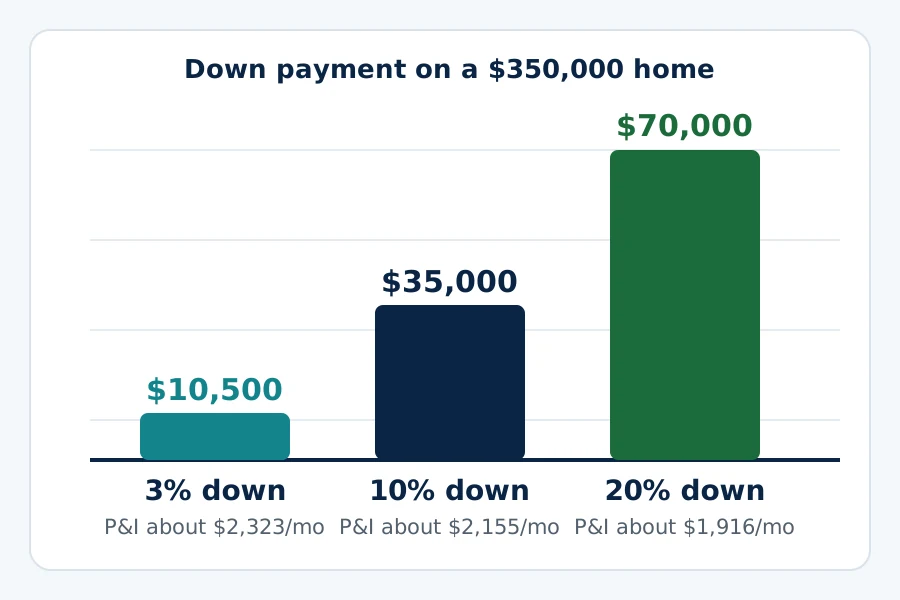
Here’s a simple example of what a first-time home buyer might need for a $350,000 home (a made-up price, used only for the math):
| Loan type | Down payment | Closing costs (2%–5%) | Total cash needed |
|---|---|---|---|
| Conventional, 3% down | $10,500 | $7,000–$17,500 | $17,500–$28,000 |
| FHA, 3.5% down | $12,250 | $7,000–$17,500 | $19,250–$29,750 |
| Conventional, 10% down | $35,000 | $7,000–$17,500 | $42,000–$52,500 |
| Conventional, 20% down | $70,000 | $7,000–$17,500 | $77,000–$87,500 |
Estimates only. Earnest money (often 1%–3% of the price) is usually credited toward your down payment or closing costs, not added on top.
For a first-time home buyer, a low down payment gets you in the door sooner, but it isn’t free. You’ll borrow more, pay more interest and, in most cases, pay mortgage insurance. Neither path is “right.” It depends on how much cash you’d have left after closing.
Low Down Payment Loans for a First-Time Home Buyer
You don’t need 20% down. These are the main options a first-time home buyer can use with a small down payment.
FHA Loan
Down payment: 3.5% with a 580+ credit score; 10% for scores of 500–579.
Good for: Lower credit scores or limited savings.
Catch: Mortgage insurance is required, and it can last the life of the loan.
Fannie Mae HomeReady
Down payment: As low as 3%.
Rules: Typically a 620 credit score and income at or below 80% of your area’s median. First-time home buyers must take a homebuyer course.
Freddie Mac Home Possible
Down payment: As low as 3%.
Rules: Similar to HomeReady, with income limits of 80% of area median. Sources list a 660 minimum score. Education is required if all borrowers are first-timers.
Lenders can set stricter standards than the programs themselves, so a program’s minimum score isn’t a promise. Check Fannie Mae’s HomeReady page and Freddie Mac’s 3% down page for income limits in your county. NerdWallet’s first-time homebuyer hub is also a good place to compare lenders and calculators.
The FHA Mortgage Insurance Cost
FHA loans are popular with first-time home buyers, but they charge an upfront premium of 1.75% plus an annual premium of 0.55%. Per Homes.com, the annual premium lasts the full 30 years unless you put down at least 10%. On a conventional loan, private mortgage insurance (PMI) can usually be removed once you reach 20% equity.
A smaller down payment means a bigger loan and more interest. With FHA, permanent mortgage insurance can add up over decades. You may be able to refinance later, but that depends on rates and your equity, and nobody can promise either.
What Your Monthly Payment Could Look Like
Using the 7.28% Freddie Mac average as a rough benchmark, here’s what a first-time home buyer might pay in principal and interest on that same $350,000 home. Your real rate will differ based on your credit, loan type and lender.
| Down payment | Loan amount | P&I at 7.28% | P&I at 6.28% |
|---|---|---|---|
| 3% ($10,500) | $339,500 | about $2,323 | about $2,097 |
| 3.5% FHA ($12,250)* | $343,661* | about $2,351 | about $2,123 |
| 10% ($35,000) | $315,000 | about $2,155 | about $1,946 |
| 20% ($70,000) | $280,000 | about $1,916 | about $1,729 |
*FHA loan amount includes the 1.75% upfront premium rolled into the loan. All figures exclude property taxes, homeowners insurance, ongoing mortgage insurance and HOA dues, which can add hundreds of dollars a month. Our own calculations, for illustration only.
In this example, a one-point lower rate saves roughly $226 a month on the 3%-down loan. That’s why shopping several lenders matters.
7 Steps Every First-Time Home Buyer Should Follow
- Check your credit. Pull your free reports and fix any errors. A higher score can mean a lower rate and more loan choices.
- Know your debt-to-income ratio. Lenders compare your monthly debts to your income. Many prefer 43% or lower, though some programs allow more.
- Set a budget based on the monthly payment, not the max approval. Being approved for a number doesn’t mean it fits your life.
- Take a homebuyer class. It’s required for some loans, and it can open the door to assistance programs.
- Get preapproved with more than one lender. Compare rates, fees and the official Loan Estimate side by side.
- Look into state help. Many state housing agencies offer down payment aid or a Mortgage Credit Certificate (see below).
- Get an inspection before you close. Skipping it to win a bidding war can cost far more later.
Ways to Save Faster
If you’re a first-time home buyer, automate a monthly transfer to a high-yield savings account. Cut one or two recurring bills. If your schedule allows, extra income helps too. Our guide to AI side hustles for 2027 covers some ideas, though earnings vary and aren’t guaranteed.
Gifts from family are common. NAR reports that 22% of first-time home buyers used a gift or loan from family or friends for their down payment.
Help You Might Qualify For
Mortgage Credit Certificate (MCC)
An MCC turns part of your yearly mortgage interest into a federal tax credit, up to $2,000 per year. You claim it on IRS Form 8396. It’s issued through state or local housing agencies, so availability varies. Many programs define a first-time home buyer as someone with no ownership interest in a primary home in the past three years. The credit only helps if you owe enough federal tax to use it.
Down Payment Assistance
State and local housing finance agencies offer grants, forgivable loans and low-interest second loans. Rules, income caps and amounts differ widely. Search your state’s housing finance agency before you pick a lender, because some programs only work with certain loans.
The federal first-time home buyer tax credit offered from 2008 to 2010 ended, and we couldn’t find a replacement as of this writing. Be careful with ads that suggest otherwise.
Common Mistakes to Avoid
- Spending every dollar on the down payment. Keep an emergency fund. Repairs show up fast in the first year.
- Opening new credit before closing. A new car loan or card can change your approval.
- Ignoring property taxes and insurance. They’re part of your real monthly cost.
- Taking the first loan offer. Compare at least three.
- Counting on a rate drop. Rates have moved up and down this fall. Buy only if today’s payment works.
NerdWallet notes that rent-to-own contracts are often complex and costly. If you’re considering one, talk with a financial professional and a lawyer first.
Should You Buy Now or Wait?
Nobody can time rates. Here’s a practical way to decide: if the payment fits your budget with room left over, you have an emergency fund, and you plan to stay for several years, buying can make sense. If the payment is tight, waiting while you build savings and credit is a fair choice. You can also run a rent-versus-buy comparison using your local rent and prices.
This is our opinion, not financial advice. Home buying is personal, and a loan officer or HUD-approved housing counselor can look at your actual numbers.
Bottom Line
As a first-time home buyer, you can start with as little as 3% to 3.5% down, but you’ll still need closing costs and a safety cushion. Know your numbers, compare lenders, check your state’s assistance programs, and choose a payment you can live with. Start with the preapproval step this week and you’ll know exactly where you stand.
Information is current as of Nov. 24, 2026. Rates, rules and program details change often. Confirm details with your lender and the program websites linked above. TechAndWealth.com provides general information, not financial or legal advice.