

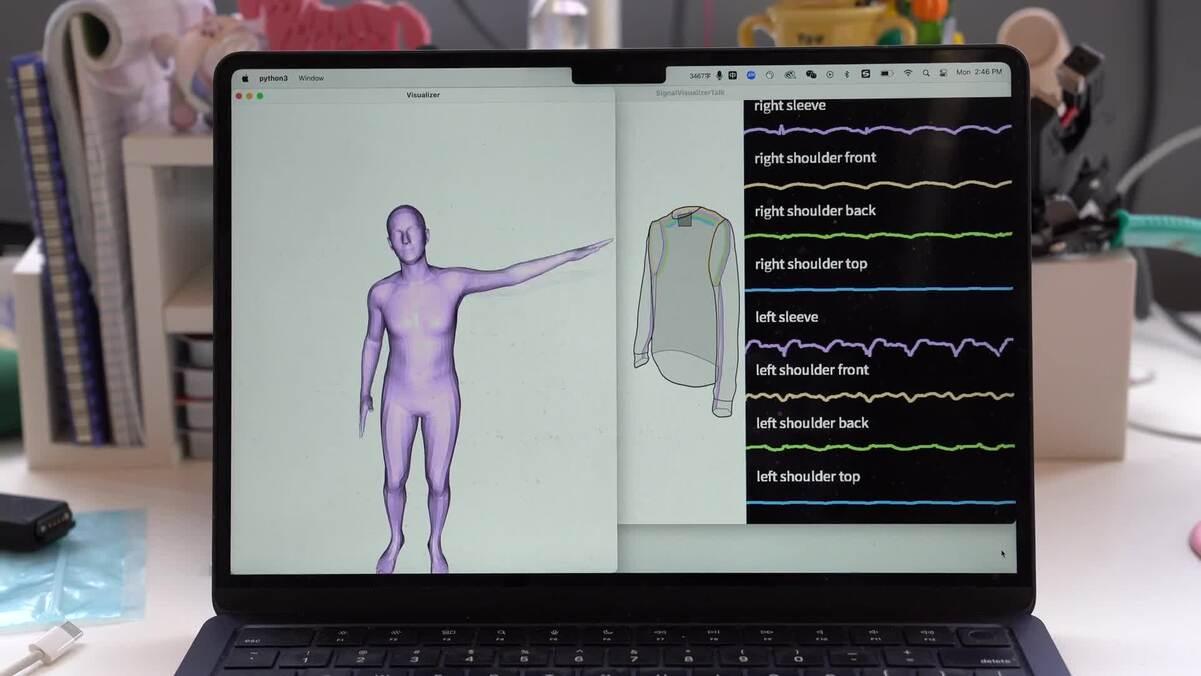
Smartwatch AI Body Tracking has taken an exciting step forward with EchoMotion, a new research system developed at Cornell University. Researchers have demonstrated that an ordinary smartwatch can estimate full-body movements using ultrasonic sound waves and artificial intelligence—without requiring cameras or additional body-worn sensors.
The research, reported on November 11, 2026, could eventually help transform fitness tracking, exercise coaching and human-computer interaction. However, EchoMotion remains an experimental technology rather than a standard feature available to smartwatch buyers today.
What Is Smartwatch AI Body Tracking?
Smartwatch AI Body Tracking refers to using artificial intelligence and smartwatch sensors to estimate how different parts of a person’s body move.
Most conventional smartwatches measure activity using accelerometers, gyroscopes and other sensors. These can detect wrist movement, but they do not directly track the positions of the entire body.
Cornell University’s EchoMotion system takes a different approach. It uses ultrasonic echoes captured through a smartwatch’s built-in speaker and microphone to estimate the positions of multiple body joints.
The research was developed by Cornell’s Smart Computer Interfaces for Future Interactions (SciFi) Lab, led by associate professor Cheng Zhang.
How Does EchoMotion Work Without Cameras?
EchoMotion uses a sensing technique similar in principle to sonar.
A smartwatch emits ultrasonic signals through its speaker. These sound waves interact with the wearer’s body, and reflected echoes are captured by the microphone.
A lightweight AI model analyses the echo patterns to estimate body positions.
Because the system relies on acoustic sensing rather than video recording, it may offer privacy advantages in environments such as homes and gyms.
The technology does not require a camera to estimate the tested body poses, although its performance depends on the quality of the acoustic signals.
5 Amazing Smartwatch AI Body Tracking Breakthroughs
1. Full-Body Tracking With a Single Smartwatch
EchoMotion estimates the positions of 12 body joints, including joints from the head to the ankles.
This is notable because many body-tracking systems rely on cameras or multiple wearable devices.
2. Works on Existing Commercial Hardware
Researchers tested the system on an unmodified Samsung Galaxy Watch 6.
They also demonstrated that the same AI model could operate on a Galaxy Watch 7 and Google Pixel Watch 3 without retraining.
This suggests that future applications may be possible without requiring entirely new smartwatch hardware.
3. Promising Tracking Accuracy
In testing with 15 new participants using the Galaxy Watch 6, researchers reported average joint-position errors below 10 centimetres.
A one-time calibration lasting approximately 12 minutes reduced the average error to around 6.1 centimetres.
These are experimental results, not guaranteed accuracy levels for everyday consumers.
4. Low Power Consumption
The EchoMotion prototype used approximately 12 milliwatts for sensing, according to the research report.
A 30-minute tracking session on the Galaxy Watch 6 consumed approximately 5%–6% of its battery.
Low power requirements could make continuous or repeated sensing more practical in future wearable applications.
5. Potential for AI Fitness Coaching
Researchers are exploring ways to use EchoMotion for fitness tracking, including counting exercise repetitions and identifying movement patterns.
Future systems might help users assess exercise form or monitor physical activities without setting up cameras.
However, these applications remain under development.
Which Smartwatches Were Tested?
The research involved three commercially available smartwatch models.
| Smartwatch | Research Findings |
|---|---|
| Samsung Galaxy Watch 6 | Tested with 15 new participants; joint-position accuracy measured |
| Samsung Galaxy Watch 7 | Same AI model demonstrated without retraining |
| Google Pixel Watch 3 | Same AI model demonstrated without retraining |
Importantly, this does not mean that EchoMotion is currently available as a built-in consumer feature on these watches.
Why Is Camera-Free Body Tracking Important?
One potential advantage of Smartwatch AI Body Tracking is improved privacy.
Camera-based systems may capture images of people, rooms and surrounding objects. Acoustic sensing can estimate movement without recording video footage.
The approach could also reduce the need for expensive motion-capture equipment.
Potential applications include fitness coaching, movement analysis, virtual reality and interactive computing.
Researchers will still need to address accuracy, reliability and real-world deployment before these benefits become widely available.
What Are the Current Limitations?
EchoMotion has several important limitations.
The researchers initially collected training data from 10 volunteers performing 18 exercises. They then conducted additional smartwatch testing and real-world experiments.
In crowded or confined spaces, echoes from nearby people can interfere with tracking accuracy.
Although furniture and ambient noise did not significantly disrupt the reported tests, the system performed somewhat worse in a narrow hallway because of reflections involving other people.
The research also does not establish that EchoMotion can diagnose medical conditions or replace clinical motion-analysis equipment.
Can You Use EchoMotion on a Smartwatch Today?
Not as a standard commercial feature.
The research demonstrates that the technology can run on existing smartwatch hardware, but there is no confirmed consumer release date or publicly announced retail integration.
Buying a Galaxy Watch 6, Galaxy Watch 7 or Pixel Watch 3 does not automatically provide access to EchoMotion.
Consumers should distinguish between the capabilities of the smartwatch itself and experimental software demonstrated by university researchers.
What Does This Mean for the Future of Wearable AI?
Smartwatch AI Body Tracking illustrates how smaller AI models could enable new sensing capabilities on everyday devices.
Instead of relying exclusively on cameras or multiple sensors, future wearable systems may interpret acoustic information to understand movement.
If researchers can improve performance in crowded environments and validate the system across larger populations, similar technologies could eventually support more advanced fitness and activity-tracking experiences.
The development also highlights opportunities for on-device AI, where lightweight models perform useful tasks without depending on large cloud-based systems.
Final Thoughts
Smartwatch AI Body Tracking could become an important area of wearable technology as researchers develop new ways to understand human movement.
Cornell University’s EchoMotion system demonstrates that ultrasonic sensing and lightweight AI can estimate full-body poses using commercially available smartwatch hardware.
Its experimental accuracy, relatively low power consumption and camera-free approach are promising, but practical consumer applications will require further testing and development.
For now, EchoMotion is a research breakthrough—not a feature that smartwatch buyers should expect to find in retail products.
Research source: Cornell University, November 11, 2026.
Original paper: EchoMotion: Towards Full-Body Pose Tracking with a Single Smartwatch Using Active Acoustic Sensing.
Editorial note: Accuracy and battery measurements refer to reported research conditions. Consumer availability has not been announced.