

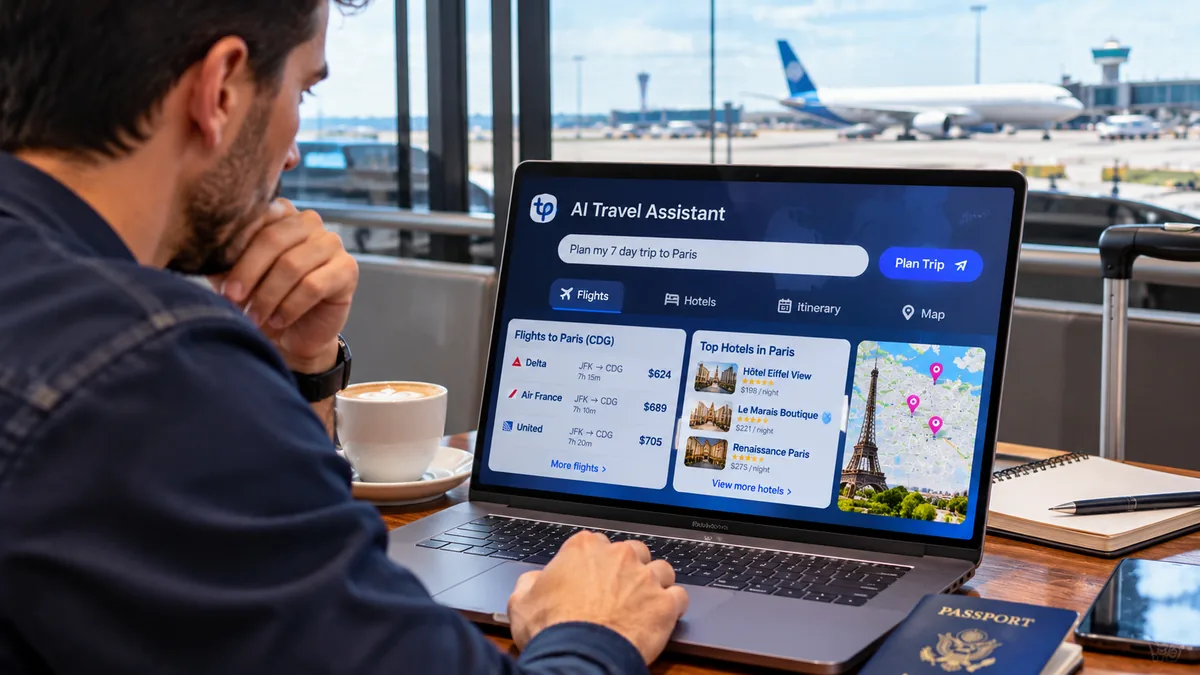
- Planning a vacation can take almost as much time as the trip itself. You need to compare flights, find hotels, check prices, research attractions, plan transportation, and make sure everything fits your budget.
That is where AI Travel Agents are starting to make a difference.
Instead of opening dozens of browser tabs and manually comparing every option, travelers can now describe their ideal vacation in everyday language and get personalized suggestions. Artificial intelligence can help build itineraries, compare travel options, discover local attractions, and organize trip details.
For Americans planning domestic vacations or international travel, AI is becoming a useful travel companion. However, it is important to understand what these tools can actually do, where they still have limitations, and when a human should make the final decision.
What Are AI Travel Agents?
AI travel agents are digital assistants that use artificial intelligence to help people research, organize, and sometimes book trips.
Traditional travel websites generally require users to enter specific details, apply filters, and compare results manually. AI-powered travel assistants make the process more conversational.
For example, instead of searching separately for flights, hotels, restaurants, and attractions, you could ask:
“Plan a five-day vacation in California for two adults, with a total budget of $2,500. Include a comfortable hotel, scenic attractions, local restaurants, and affordable transportation.”
An AI assistant can use your requirements to create a starting itinerary and suggest options that match your preferences.
The biggest advantage of AI Travel Agents is that they can turn a complicated travel search into a simpler conversation.
However, recommendations are not the same as confirmed reservations. Travelers should always verify prices, availability, cancellation policies, and booking details before paying.
Why Americans Are Starting to Use AI Travel Agents
AI-assisted travel planning is gaining attention in the United States.
According to Phocuswright’s March 2026 research, 56% of active U.S. travelers had used AI for planning, booking, or in-destination assistance for at least one trip during the previous 12 months. The figure had increased from 43% in the second half of 2025 and 33% in the first half of 2025.
A separate Longwoods International survey reported that 28% of American travelers had used AI to plan a trip in the previous six months, based on its July 2026 survey.
These figures come from different surveys with different definitions of AI use, so they should not be treated as directly comparable. Still, both indicate growing interest.
Sources:
- Phocuswright: The Fastest Shift in Travel Behavior
- Longwoods International: American Travel Sentiment Wave 109
Why are travelers interested?
- Less research time: AI can organize information that would otherwise require multiple searches.
- Personalized recommendations: Suggestions can reflect budget, interests, travel dates, and group size.
- Better organization: It can turn scattered ideas into a day-by-day itinerary.
- More options: Travelers can explore destinations and activities they may not have considered.
- Budget awareness: AI can help compare alternatives and identify expenses that might otherwise be overlooked.
AI is not simply changing where people search for vacations. It is changing how they make travel decisions.
7 Ways AI Travel Agents Are Changing Trip Planning
1. Personalized Vacation Planning
One of the most useful features of AI Travel Agents is their ability to work with detailed preferences.
A family traveling with children may need family-friendly hotels, shorter driving distances, and activities suitable for different ages. A couple planning an anniversary trip may prefer scenic locations, romantic restaurants, and boutique hotels.
AI can use these details to create a more relevant starting plan.
For example, a traveler could request:
“Plan a seven-day road trip from Los Angeles to San Francisco. Include coastal attractions, affordable hotels, scenic stops, and restaurants under $40 per person.”
The assistant can organize suggestions around the route and the traveler’s preferences.
The important point is to provide clear information. The more specific your dates, budget, interests, and restrictions, the more useful the recommendations are likely to be.
2. Finding and Comparing Flights
Flight research can be frustrating because prices change, routes differ, and baggage rules are not always the same.
AI-powered travel tools can help travelers compare flight options using details such as:
- Departure and arrival airports
- Preferred travel dates
- Direct or connecting flights
- Departure times
- Baggage requirements
- Price limits
- Airline preferences
Google has expanded AI Mode in Search with travel-related features. Its August 2026 announcement described flight-price tracking, points and miles information, and hotel booking capabilities within AI Mode.
Read Google’s announcement: New Ways to Plan and Book Travel in Search.
AI can make flight research easier, but the final fare should always be checked on the airline or booking partner’s website before purchase.
A displayed price may change, and important conditions such as baggage fees, seat selection, and refund eligibility may not be included in the initial comparison.
3. Smarter Hotel Recommendations
Finding a hotel is about more than choosing the lowest price.
Travelers may care about location, cleanliness, parking, breakfast, accessibility, family facilities, or proximity to public transportation.
AI travel assistants can help narrow the choices by understanding these requirements.
For example:
“Find a hotel in New York City under $250 per night, close to public transportation, with good recent guest reviews and free cancellation.”
Google’s AI travel features can use information from Google Hotels, while Expedia Group has introduced AI-powered hotel search and comparison experiences.
In its October 28, 2026 product release, Expedia Group announced natural-language search for vacation rentals through Vrbo and AI Compare for comparing shortlisted hotel properties through Hotels.com.
Source: Expedia Group Fall 2026 Product Release.
4. Creating Day-by-Day Travel Itineraries
A good itinerary should make sense geographically and practically.
For example, visiting attractions located on opposite sides of a city on the same afternoon can waste valuable time.
AI can help organize activities by neighborhood, estimate travel distances, and arrange a practical daily schedule.
Google explained in an August 2026 article how Gemini can use information from Google Maps, Flights, and Hotels to help create personalized travel itineraries.
It can also consider existing plans and preferences when building a schedule, depending on the features and permissions available.
Source: Google: How Gemini Plans Custom Vacation Itineraries.
A useful itinerary might include:
- Morning: Visit a major attraction.
- Lunch: Choose a nearby restaurant.
- Afternoon: Explore a local neighborhood or museum.
- Evening: Enjoy a sunset location or local event.
The real value is not just getting a list of attractions. It is organizing them into a trip that makes sense.
5. Discovering Local Restaurants and Hidden Attractions
Travelers often want experiences beyond the most famous tourist attractions.
AI assistants can suggest local restaurants, museums, walking routes, outdoor activities, and lesser-known places based on a traveler’s interests.
For example, someone visiting Austin, Texas, might ask for live music venues, barbecue restaurants, outdoor activities, and family-friendly attractions.
According to Longwoods International’s July 2026 survey, among American travelers who had used AI for trip planning:
- 54% used it to find attractions and activities.
- 44% used it for inspiration about places to visit.
- 42% used it to find dining options.
These results suggest that AI is becoming useful for more than flight and hotel research.
However, recommendations should be checked against recent reviews, official business websites, opening hours, and current event schedules.
6. Organizing Bookings and Travel Documents
A vacation often involves multiple confirmations: flights, hotels, rental cars, tours, restaurant reservations, and transportation.
Keeping everything organized can be difficult.
Some AI assistants can help summarize travel-related emails, organize booking information, prepare packing lists, and create a master itinerary.
For example, Google has described how Gemini can use connected Google services, with the user’s permission, to reference travel information and help organize existing plans.
This can be particularly useful for families or travelers managing several reservations.
Before connecting any account, review the permissions carefully. Avoid sharing passport numbers, payment card details, or other sensitive information unless a service genuinely requires it and you trust its security practices.
7. Getting Travel Assistance During the Trip
AI travel assistance does not have to stop after booking.
During a vacation, travelers may need help finding nearby restaurants, understanding local transportation, adjusting an itinerary, or discovering activities when the weather changes.
You could ask:
“Rain is expected in Seattle tomorrow. Suggest three indoor activities near downtown that fit a family budget.”
An AI assistant can suggest alternatives and help reorganize the day.
Some travel platforms are also adding AI-powered customer support. Expedia Group’s October 2026 announcement, for example, included an AI voice agent for Vrbo customer support.
But AI support is not a substitute for emergency services, official travel advisories, or direct help from an airline or hotel when a serious problem occurs.
Popular AI Travel Tools Americans Can Explore
Several established technology and travel companies are adding AI features to their products.
Google Gemini
Gemini can help research destinations, build itineraries, and work with information from Google Maps, Flights, and Hotels. Available features depend on the user’s account, location, and settings.
Official website: Gemini
Google Search AI Mode
Google’s AI Mode includes travel-related capabilities such as flight-price tracking and hotel discovery and booking features announced in 2026. Availability can vary by feature and market.
Official information: Google AI Mode Travel Updates
Expedia
Expedia Group is integrating AI into travel discovery, hotel comparisons, activity planning, and customer support across its travel brands.
Official website: Expedia
Hotels.com
Hotels.com has introduced AI Compare to help travelers evaluate shortlisted properties using side-by-side comparisons.
Official website: Hotels.com
Vrbo
Vrbo is adding natural-language vacation rental search and AI-powered customer support features.
Official website: Vrbo
These products do not all work in the same way. Some focus on research and recommendations, while others connect AI features more closely to travel inventory and booking services.
Can AI Travel Agents Actually Save Money?
They can help, but savings are not guaranteed.
AI may help travelers:
- Compare different travel dates.
- Identify alternative airports.
- Find hotels that fit a budget.
- Compare transportation options.
- Discover free or lower-cost attractions.
- Track flight prices where supported.
- Identify extra costs that may affect the total budget.
For example, a traveler planning a weekend in Chicago could ask an AI assistant to compare three hotel areas, estimate transportation expenses, and suggest free attractions.
The result can make it easier to compare the total cost of different plans rather than looking only at the flight or hotel price.
Think of AI as a research assistant that helps you make a smarter comparison, not as a machine that guarantees the cheapest deal.
Always compare the final price, taxes, baggage charges, resort fees, cancellation conditions, and payment terms before booking.
The Risks: What Travelers Should Check Before Trusting AI
AI travel agents are useful, but they are not perfect.
Incorrect or outdated information
An AI assistant may provide an outdated hotel price, incorrect opening hours, or an attraction that is temporarily closed.
Booking mistakes
A suggested itinerary may look correct but contain unrealistic travel times, incorrect dates, or unsuitable connections.
Privacy concerns
Some AI services may request access to email, calendars, location, or other personal information. Review permissions and privacy policies before connecting accounts.
Sponsored recommendations
Some travel recommendations may be influenced by commercial partnerships or advertising. Travelers should look for clear disclosure and compare alternatives independently.
Payment and cancellation problems
Never assume that an AI-generated recommendation is a confirmed booking. Check the booking confirmation, cancellation policy, refund rules, and payment details directly with the provider.
Do not allow an AI assistant to make an irreversible payment or booking without reviewing the exact details and giving your approval.
Expedia Group’s April 2026 research highlighted this trust gap. In its survey of more than 5,700 adults across the U.S., U.K., and India, 68% said they preferred booking with a trusted travel brand over an AI chatbot or agent, even when AI booking was available.
Source: Expedia Group: The AI Trust Gap.
How to Use AI Travel Agents: A Practical Example
Imagine you are planning a five-day family vacation from New York to Orlando.
Instead of starting with separate searches, give your AI assistant a detailed request.
Try this prompt:
“Act as my travel planning assistant. I am planning a five-day family vacation from New York to Orlando for two adults and two children. My total budget is $3,500, including flights, accommodation, food, and local transportation. Suggest suitable travel dates, compare flight options, recommend family-friendly hotels, and create a day-by-day itinerary. Include estimated costs, free attractions, and practical transportation options. Clearly identify which prices and details need verification before booking.”
After receiving the plan:
- Check the flight options on the airline or booking partner’s website.
- Compare hotel prices and recent guest reviews.
- Verify attraction opening hours and ticket prices.
- Check transportation costs and distances.
- Review cancellation and refund policies.
- Confirm every booking yourself before payment.
You can also ask the assistant to revise the plan if the estimated cost is too high.
For example: “Reduce the total budget to $3,000 without removing the main family attractions.”
This approach makes AI more useful because you remain in control of the final decisions.
The Future of AI Travel Agents
The next stage of AI-powered travel is likely to involve more connected services.
Instead of only answering questions, AI assistants are moving toward helping travelers complete several steps in one workflow: researching flights, comparing accommodation, organizing activities, tracking prices, and assisting with reservations.
Google’s 2026 updates show how AI Mode is moving closer to travel discovery and booking. Expedia Group is also expanding AI features across planning, accommodation search, activities, and customer support.
In the future, travelers may be able to describe an entire vacation in one conversation, review a complete plan, approve the options they like, and manage much of the journey through a single digital assistant.
However, wider adoption will depend on accurate information, secure payments, reliable integrations, transparent recommendations, and customer trust.
The most successful AI travel services will not simply generate attractive itineraries. They will help travelers make reliable decisions and resolve problems when plans change.
Final Verdict: Are AI Travel Agents Worth Using?
Yes. AI travel agents are worth exploring if you want to reduce research time, organize a vacation, compare options, and discover activities that match your interests.
They are particularly useful during the early planning stages, when you are deciding where to go, how much to spend, and what to do.
But they should not be treated as completely independent travel experts. Always verify important information and make the final booking decision yourself.
The smartest way to travel in the AI era is simple: let artificial intelligence handle more of the research, while you stay in control of the decisions.
Disclosure: This article is for informational purposes. Some links may be commercial or affiliate links if added by the publisher. Always review the provider’s terms before booking.