
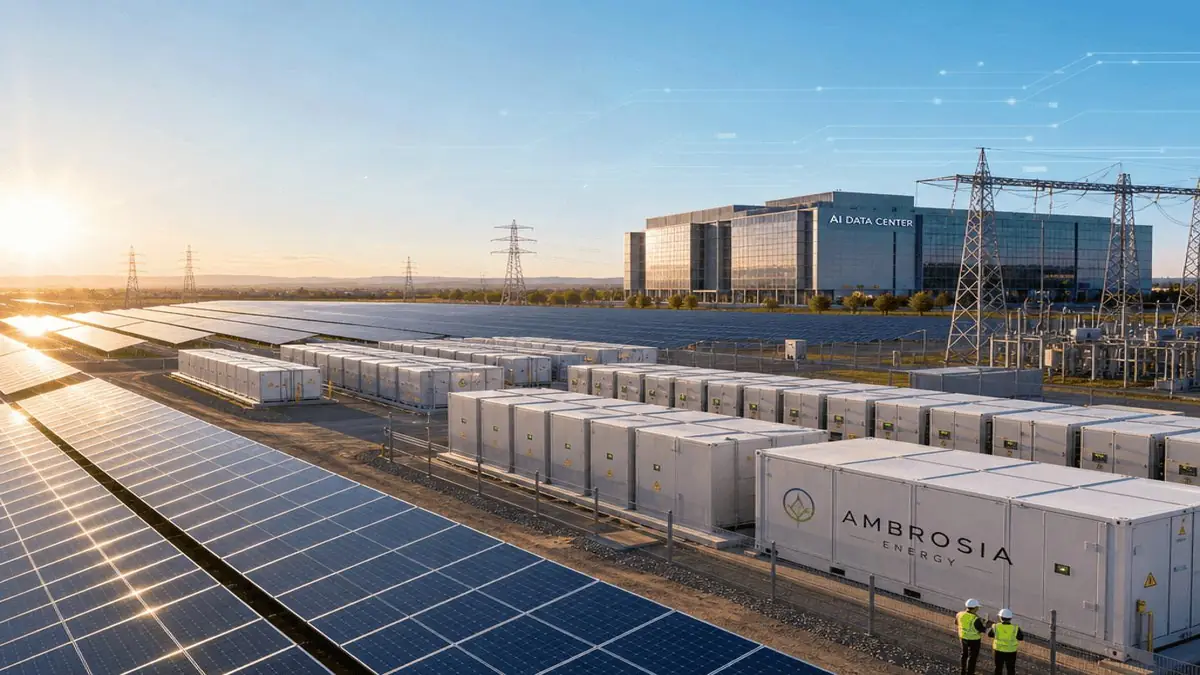
Can Sodium-Ion Batteries Transform US Data Center Energy Storage?
Artificial intelligence is changing how America uses electricity. Behind every AI chatbot, cloud platform, streaming service and online application is a data center that needs a continuous supply of power.
As these facilities grow, energy storage is becoming a major business and technology challenge. One emerging solution is sodium-ion batteries.
Unlike conventional lithium-ion batteries, sodium-ion batteries use sodium-based materials, which are widely available. They could offer data centers another way to store electricity, manage peak demand and support a more resilient power supply.
But can sodium-ion batteries really compete with lithium-ion technology? And could they become an important part of America’s AI infrastructure?
Let’s look at the technology, the companies entering the market, the opportunities and the challenges.
1. Why US Data Centers Need More Energy Storage
The United States is experiencing rapid growth in data center construction, partly because of artificial intelligence.
AI systems require powerful processors, advanced cooling systems and large amounts of electricity. As companies build more AI infrastructure, the pressure on local electricity grids is increasing.
According to the US Department of Energy, research from Lawrence Berkeley National Laboratory estimates that data centers could consume approximately 11.8% of total US electricity by 2030. The report also presents a range of 9.5% to 15.3%, depending on future demand and other assumptions.
That is a significant potential increase.
The challenge is not simply generating more electricity. Data centers also need reliable power, protection against outages and ways to manage sudden changes in electricity demand.
This is where battery energy storage systems become important.
Energy storage could help data centers use electricity more intelligently, reduce dependence on peak grid supply and support backup power strategies.
For operators planning large AI facilities, battery technology is becoming an important part of infrastructure planning.
2. What Are Sodium-Ion Batteries?
Sodium-ion batteries work on a principle similar to lithium-ion batteries. They store and release electricity through the movement of ions between two electrodes.
The main difference is the material used: sodium instead of lithium.
Sodium is widely available in nature and can be obtained from common resources such as salt. This creates the possibility of a more diversified battery supply chain.
Sodium-ion batteries are being developed for several applications, including:
- Grid-scale electricity storage
- Renewable energy storage
- Commercial and industrial power systems
- Electric mobility
- Backup and critical infrastructure
One important point: sodium-ion batteries are not automatically cheaper or better than lithium-ion batteries. Their performance depends on the specific chemistry, system design, manufacturing scale and application.
For large stationary storage projects, however, their characteristics could make them attractive.
3. Why Sodium-Ion Batteries Could Benefit Data Centers
There are several reasons why sodium-ion batteries are attracting attention from energy storage companies and data center developers.
A. More diversified raw material supply
Lithium-ion battery manufacturing depends on supply chains involving lithium, graphite, nickel and other materials, depending on the chemistry.
Sodium-ion batteries could reduce dependence on some of these materials. This may help diversify supply chains and create more options for manufacturers and buyers.
For the United States, developing domestic battery production could also become strategically important.
B. Potential safety advantages
Battery safety is a major concern for data centers because a fire or serious equipment failure can interrupt critical operations.
Some sodium-ion chemistries offer promising thermal stability characteristics. However, safety depends on the complete battery system, including cell chemistry, battery management, electrical protection, installation and fire prevention.
For data center operators, a battery system that reduces fire risk and simplifies site safety planning could have significant operational value.
Do not assume that every sodium-ion battery is fireproof. Independent testing and system-level safety certifications remain essential.
C. Performance in different temperatures
Some sodium-ion battery designs can operate across a wide temperature range.
This may be useful for outdoor energy storage installations in locations where weather conditions vary significantly.
For example, ESS says its Bridge system is designed to operate from -40°C to 50°C. That is a manufacturer specification, not a guarantee that every sodium-ion product offers the same performance.
D. Long-duration energy storage potential
Data centers may need storage for more than short power interruptions.
Depending on the system design, batteries can help shift electricity use across different hours, support renewable energy integration and reduce peak demand.
Some sodium-ion platforms are being designed for multiple discharge durations. CATL, for example, says its TENER Sodium platform supports configurations of 1, 2, 4, 6 and 8 hours.
This flexibility could be useful for large energy storage projects.
E. Reduced exposure to lithium price fluctuations
Lithium prices can move significantly with changes in global supply and demand.
Sodium-ion batteries could give energy storage developers another chemistry to consider. This does not guarantee lower total project costs, but it may reduce dependence on a single battery supply chain.
4. Sodium-Ion vs. Lithium-Ion Batteries
Lithium-ion batteries, especially lithium iron phosphate (LFP), already have a strong position in stationary energy storage.
Sodium-ion technology is still developing its manufacturing scale and commercial track record.
Here is a simplified comparison:
| Factor | Sodium-ion | Lithium-ion (LFP) |
|---|---|---|
| Main ion | Sodium | Lithium |
| Raw material availability | Sodium is widely available | Lithium supply is more concentrated |
| Energy density | Generally lower | Generally higher |
| Stationary storage potential | Promising | Established |
| Manufacturing scale | Smaller and developing | Large global industry |
| Supply chain | Potential for diversification | Mature but concentrated in key regions |
| Commercial track record | Emerging | Extensive |
The most important difference is energy density.
Lithium-ion batteries generally store more energy in a given weight or volume. That matters when space is limited.
For a large data center campus with dedicated land for battery containers, energy density may be less important than safety, cost, operating life and reliability.
The likely future is not sodium replacing lithium everywhere. It is different battery chemistries competing for the applications where they make the most economic and technical sense.
5. Companies Bringing Sodium-Ion Technology to Market
The sodium-ion market is moving beyond laboratory research. Several companies have announced commercial products, partnerships or development plans.
CATL: TENER Sodium
Chinese battery manufacturer CATL introduced its TENER Sodium energy storage system in June 2026.
According to the company, the modular platform offers more than 30 MWh of rated capacity and supports 1-, 2-, 4-, 6- and 8-hour configurations.
CATL has also announced plans for international deliveries beginning in June 2027. These are company-announced timelines and should not be treated as proof that US projects have already received the systems.
Official information: https://www.catl.com/en/news/6861.html
ESS Tech: Bridge
US-based ESS Tech introduced its Bridge modular sodium-ion battery energy storage system in July 2026.
The company describes Bridge as a 1.2 MWh building block designed for grid-scale, commercial, industrial and data center applications. It says multiple units can be combined for larger installations.
ESS has also reported a non-binding letter of intent with Juniper Energy for at least 500 MWh of potential deployments, beginning with a planned 10 MW / 80 MWh California project targeted for commercial operation in 2027.
These are announced plans and commercial intentions, not completed installations. The company’s own SEC filing notes that its first operational Bridge product was expected toward the end of 2026.
Sources:
- https://essinc.com/ess-inc-introduces-bridge/
- https://www.sec.gov/Archives/edgar/data/1819438/000181943826000072/a2026q2earningsrelease.htm
Peak Energy and Energy Vault
In February 2026, Energy Vault and Peak Energy announced a partnership to develop sodium-ion storage solutions for AI-focused data center operators.
The announcement included a 1.5 GWh supply agreement for Peak Energy’s US-manufactured sodium-ion batteries.
The companies plan to combine battery technology with energy management software and data center infrastructure.
This is an important development because it shows that some companies are designing sodium-ion systems specifically around the needs of AI infrastructure.
6. Where Could Data Centers Use These Batteries?
Sodium-ion batteries may have several potential applications across data center infrastructure.
Peak shaving
Electricity prices and grid demand can rise during peak periods.
A battery system can charge when electricity is cheaper or more available and discharge during periods of higher demand, subject to the site’s energy contract and operating requirements.
This approach is known as peak shaving.
Renewable energy storage
Data centers increasingly explore solar and wind power to support their electricity needs.
Solar generation does not always match the hours when a data center consumes the most electricity. Batteries can store surplus renewable power and release it later.
Backup and resilience
Data centers require highly reliable electricity.
Battery systems can support short-duration backup and help bridge the transition to generators or other backup sources. However, battery energy storage does not automatically replace a data center’s uninterruptible power supply (UPS), generators or other redundancy systems.
Grid support
Large battery installations can potentially help balance electricity supply and demand.
If deployed at the right locations and under suitable grid arrangements, they may support local grid stability and reduce pressure during periods of high demand.
7. Challenges That Could Slow Adoption
Despite the potential, sodium-ion batteries face important challenges.
Lower energy density
Sodium-ion batteries generally have lower energy density than established lithium-ion alternatives.
This can mean more space is required for the same amount of stored energy.
Manufacturing scale
Lithium-ion manufacturing has a significant head start. Sodium-ion production capacity, supplier networks and deployment experience are still developing.
Large customers will want confidence that manufacturers can deliver equipment, spare parts and long-term technical support.
Cost uncertainty
Sodium is abundant, but that does not automatically make a complete sodium-ion storage system cheaper.
The final cost depends on cells, manufacturing yields, power conversion equipment, installation, financing, maintenance and project life.
Buyers need to compare the total cost of ownership rather than looking only at the price of raw materials.
Commercial track record
Data centers cannot afford experimental power infrastructure without proper testing.
Operators will need independent performance data, safety certifications, warranties and evidence from real-world deployments before adopting sodium-ion systems at large scale.
The biggest challenge for sodium-ion batteries is not proving that the chemistry can work. It is demonstrating reliable performance and competitive economics at commercial scale.
8. The Business Opportunities Ahead
The growth of AI infrastructure could create opportunities across the energy storage industry.
Potential beneficiaries may include:
- Battery cell manufacturers
- Battery management system developers
- Energy storage system integrators
- Power conversion equipment manufacturers
- Data center energy consultants
- Renewable energy developers
- Grid infrastructure companies
- Software providers for energy management
There may also be opportunities for companies that design, install and maintain large battery storage projects.
For technology businesses, the opportunity is broader than manufacturing batteries. Monitoring software, energy optimisation, safety systems and grid integration will also matter.
9. What Could Happen by 2030?
The next few years will be important for sodium-ion technology.
Three developments will determine how quickly the market grows:
- Manufacturing expansion: Can suppliers increase production while maintaining quality and reducing costs?
- Real-world deployments: Can commercial projects demonstrate reliable operation over several years?
- Competitive economics: Can sodium-ion systems compete with LFP and other storage technologies on total project cost?
The United States has a strong reason to explore alternative battery supply chains as electricity demand grows.
However, forecasts should not be confused with confirmed orders or installed capacity. Announced projects, letters of intent and company targets are early indicators—not proof of future market share.
My assessment is that sodium-ion batteries could become a meaningful option for stationary energy storage by 2030, particularly where supply-chain diversification, temperature performance and system-level safety are priorities.
But lithium-ion batteries are likely to remain a major competitor because of their established manufacturing ecosystem and commercial experience.
10. Final Verdict: Could Sodium-Ion Batteries Power America’s AI Future?
Sodium-ion batteries are worth watching because the energy demands of AI data centers are creating new opportunities for battery storage.
Their potential advantages include widely available raw materials, supply-chain diversification and promising performance in certain stationary storage applications.
But there are still questions around manufacturing scale, energy density, cost and long-term commercial performance.
The most realistic future is a mix of technologies. Lithium-ion batteries will continue to play a major role, while sodium-ion systems may find their place in selected grid-scale and data center applications.
For America’s AI infrastructure, the real winner may not be one battery chemistry. It may be the ability to combine different storage technologies to deliver reliable, affordable electricity.
Frequently Asked Questions
Are sodium-ion batteries better than lithium-ion batteries?
Not in every situation. Sodium-ion batteries offer potential advantages in material availability and some operating conditions, while lithium-ion batteries generally have higher energy density and a more mature manufacturing ecosystem.
Can sodium-ion batteries power AI data centers?
They could support data center energy storage, peak shaving and grid services. Their suitability depends on the facility’s power requirements, storage duration, safety standards and economics.
Are sodium-ion batteries commercially available in the US?
Commercial products and market announcements exist, but availability, delivery schedules and project deployment vary by manufacturer. Buyers should verify current product status and certifications directly with suppliers.
Which companies are developing sodium-ion energy storage?
Companies with notable announcements include CATL, ESS Tech and Peak Energy, alongside partnerships involving Energy Vault.
Will sodium-ion batteries replace lithium-ion batteries by 2030?
A complete replacement is unlikely. Different battery chemistries are likely to serve different applications depending on cost, energy density, safety, supply and performance.
Editorial note: This article is for technology and industry information. It is not investment advice or a recommendation to buy shares in any company.