
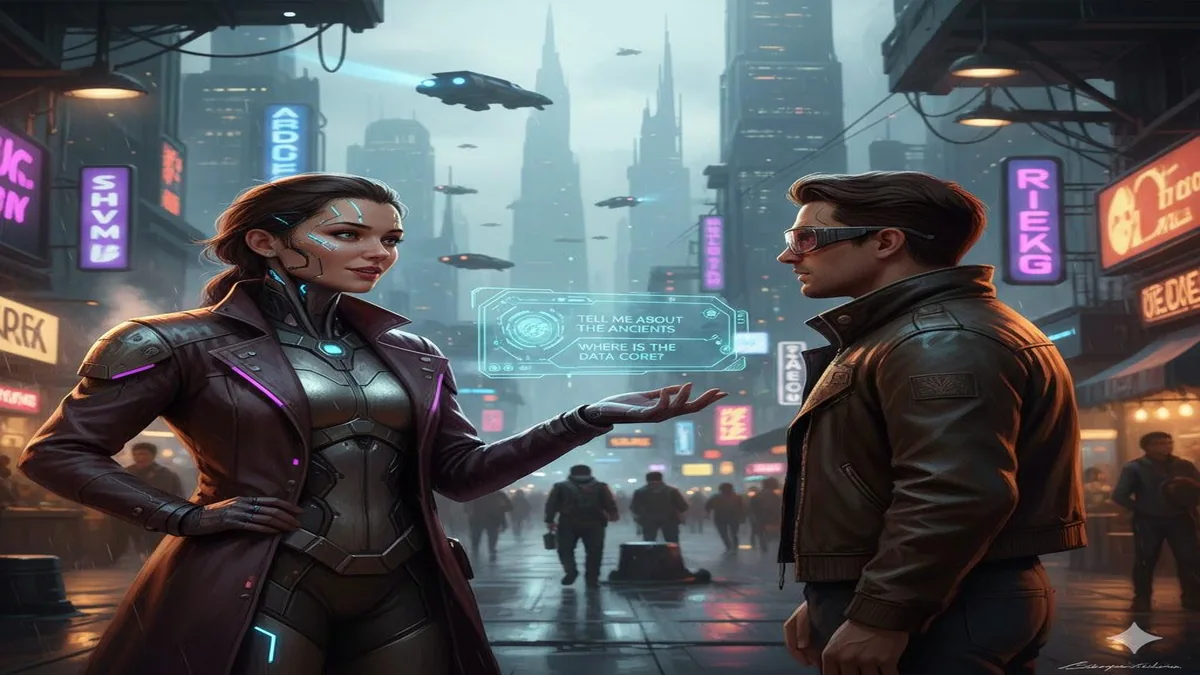
AI-Powered NPCs: How Artificial Intelligence Is Creating More Realistic Video Game Worlds
Imagine walking into a virtual restaurant and asking a character a question that was never written into the game’s script. Instead of repeating the same recorded sentence, the character understands what you said, remembers your previous conversation and responds naturally.
That is the kind of experience AI-powered NPCs could bring to video games.
Non-player characters, commonly known as NPCs, have always helped make video game worlds feel alive. They are shopkeepers, pedestrians, police officers, enemies, teammates and background characters who make a virtual environment feel populated.
But a new generation of artificial intelligence is changing what these characters might be able to do.
A recent NPR report about Grand Theft Auto VI highlighted an important part of this experience: small background conversations, known in the gaming industry as “barks”, help make a fictional world feel believable. The report also explored how game studios are considering AI tools to assist with dialogue and character interactions.
The bigger question is whether AI-powered NPCs will turn video games into worlds where characters can genuinely interact with players rather than simply follow pre-written scripts.
What Are NPCs in Video Games?
NPC stands for non-player character. These are characters controlled by the game rather than directly by the person playing it.
Traditional NPCs operate using programmed instructions, behaviour rules, animations and dialogue.
For example:
- A shopkeeper welcomes the player and offers items.
- A police officer reacts when the player breaks the law.
- A pedestrian walks through a street and reacts to nearby events.
- An enemy attacks when the player enters a certain area.
- A teammate follows instructions during a mission.
These systems can be sophisticated. Traditional game AI has been used for decades to control movement, decision-making, combat and interactions.
However, most traditional NPC conversations are limited to dialogue written and recorded before the game is released.
This is where generative AI could make a difference.
How AI-Powered NPCs Work
AI-powered NPCs can combine several technologies to create more flexible interactions.
The exact system depends on the game and developer, but it may include:
1. Large language models (LLMs)
These models process language and generate responses based on the player’s questions, the character’s personality and available game information.
2. Speech recognition
Speech recognition converts a player’s spoken words into text or another machine-readable representation.
3. Text-to-speech technology
This technology allows a character to speak generated responses instead of displaying only text.
4. Memory systems
A memory component can help a character retain selected information from earlier interactions, such as a player’s previous decision or a completed task.
5. World awareness
The NPC needs information about what is happening in the game. For example, it should know whether the player is in a shop, near an enemy or speaking during a mission.
6. Animation and behaviour systems
The character’s facial expressions, body movements and actions need to match the conversation and the rules of the game.
The real breakthrough is not simply making an NPC talk. It is connecting conversation, memory, personality and behaviour to the actual game world.
What Grand Theft Auto VI Shows About Realistic NPCs
Grand Theft Auto VI provides a useful example of why small character interactions matter.
In its November 19, 2026 report, NPR explored how everyday background dialogue helps create the atmosphere of the game’s fictional world.
These short lines of dialogue are called “barks”. They might be a conversation between pedestrians, a comment from someone in a bar or a reaction when the player approaches.
Rockstar’s writers created this kind of dialogue as part of the game’s detailed environment.
The important point is that realistic NPCs do not necessarily require generative AI. Human writers, voice actors, animation teams and carefully designed scripts can create convincing characters.
The NPR report also discussed the creative industry’s debate over using AI to generate some of this dialogue.
That distinction matters: there is no basis in the report for claiming that GTA VI’s background characters are powered by generative AI. Its example demonstrates the value of detailed human-created dialogue, while other companies are experimenting with AI-assisted alternatives.
Source: NPR report, How non-player characters in Grand Theft Auto VI help create its big world.
How Game Companies Are Experimenting With AI NPCs
Several major technology and gaming companies are exploring ways to make characters more responsive.
Ubisoft Ghostwriter: Helping Writers Create Dialogue
Ubisoft introduced Ghostwriter, an internal AI tool developed by its La Forge research team.
The tool was designed to generate first drafts of short NPC dialogue lines, often called barks. Human writers can then select, edit and refine the suggestions.
The purpose is to reduce repetitive writing work, not automatically create an entire game’s story.
Ubisoft has also explored more interactive characters through its NEO NPC experiment, which combines generative AI with speech, animation and character design.
These projects demonstrate that AI can be used in different ways: as a writing assistant or as part of a character that responds during gameplay.
Official sources:
- Ubisoft Ghostwriter: https://news.ubisoft.com/en-us/article/7Cm07zbBGy4Xml6WgYi25d/the-convergence-of-ai-and-creativity-presenting-ghostwriter
- Ubisoft NEO NPC: https://news.ubisoft.com/en-gb/article/5qXdxhshJBXoanFZApdG3L
NVIDIA ACE: Characters That Can Talk and Act
NVIDIA is developing its Avatar Cloud Engine (ACE) technology for game developers.
ACE provides AI technologies for speech, intelligence and animation. The aim is to help developers create characters that can understand player input and respond more dynamically.
NVIDIA has described applications such as AI companions, characters that respond to their surroundings and opponents that adapt to player behaviour.
Its technology can use cloud-based or on-device models, depending on the implementation.
Official source: https://developer.nvidia.com/ace-for-games
Inworld AI: Building Conversational Game Characters
Inworld provides technology for developers who want to create interactive characters.
Its platform supports voice, language and character interactions, with integrations designed for game development environments.
This type of technology could help a developer create a shopkeeper, guide, companion or story character who responds to more than a small set of fixed dialogue options.
Official source: https://inworld.ai/gaming-media
AI-Powered NPCs vs Traditional NPCs
The two approaches have different strengths.
| Feature | Traditional NPCs | AI-powered NPCs |
|---|---|---|
| Dialogue | Mostly pre-written | Can generate responses |
| Player interaction | Often limited | Potentially more flexible |
| Memory | Scripted or limited | Can use memory systems |
| Behaviour | Rules and programmed logic | Can combine rules with AI |
| Story control | Easier to predict | Requires additional controls |
| Computing needs | Often relatively predictable | May require extra processing |
| Development | Writing and programming intensive | AI integration and testing required |
AI-powered NPCs are not automatically better.
A carefully written traditional character may be more entertaining, consistent and emotionally convincing than an AI character that produces generic or irrelevant responses.
The best approach may combine both systems.
How AI Could Change the Gaming Experience
1. Conversations That Feel More Natural
Imagine entering a game shop and asking the shopkeeper about a particular item.
A traditional NPC might offer three fixed responses. An AI-powered character could potentially understand a wider range of questions and respond using information about the shop and the game.
This could make ordinary interactions feel less repetitive.
2. Characters That Remember Your Decisions
Imagine helping a character during one mission and meeting them again several hours later.
An NPC with a suitable memory system could remember that event and respond differently.
This could create a stronger sense of continuity between missions.
However, developers would need to decide what the character remembers, how long the information remains available and whether it can affect the story.
3. More Intelligent Enemies
AI could also support enemies that adapt to player behaviour.
For example, an opponent might change tactics when the player repeatedly uses the same strategy.
This does not necessarily require a language model. Conventional game AI, machine learning and carefully designed decision systems can all contribute to more challenging opponents.
4. More Personalised Game Stories
In the future, a game might offer different conversations or character reactions based on the player’s choices.
Two players could experience different interactions even when they visit the same location.
The challenge is keeping those experiences consistent with the game’s main story.
5. More Believable Virtual Worlds
Imagine a city where pedestrians discuss events, react to changing situations and interact with each other in ways that feel less repetitive.
That could make open-world games more immersive.
But believable worlds require much more than dialogue. Movement, facial expressions, sound, environmental details and consistent behaviour all matter.
What Does Research Say About AI-Powered NPCs?
The technology is promising, but it is still developing.
A 2026 systematic mapping study published in IEEE Transactions on Games examined research on large language model-based NPCs. It analysed 377 papers and assessed 42 studies in detail.
The study identified several important engineering challenges.
For example, response times in the analysed systems ranged from approximately 2.6 to 15 seconds. That is a significant issue for games that depend on quick, natural conversations.
The study also found that short-term memory and grounding responses in the game world were more common than long-term memory and retrieval-based systems.
This tells us something important: making an NPC produce a sentence is relatively easy compared with making it remember events, understand the game situation and respond consistently.
Research source: LLM-Based NPCs in Video Games: A Systematic Mapping Study.
Another 2026 study in the International Journal of Human-Computer Interaction examined player interactions with generative AI NPCs in a virtual reality game.
Players appreciated the freedom to express themselves and the feeling of immersion when characters responded convincingly. However, unnatural conversations, incorrect responses and inconsistent dialogue could damage the experience.
Research source: Dialogs with GenAI NPCs: Exploring Player Interactions with Speech Agents in a VR Game.
The research suggests that AI can make interactions more flexible, but believable responses depend on context, consistency and good game design.
The Biggest Challenges for AI-Powered NPCs
There are several reasons why AI-driven characters may not become standard in every game immediately.
Response speed
Players expect immediate reactions. Waiting several seconds for an NPC to answer can interrupt the experience.
Computing costs
AI models require processing power. Running many intelligent characters at the same time could increase hardware, cloud and operating costs.
Story consistency
An AI character might provide information that conflicts with the game’s official story.
Developers need systems that restrict responses to the character’s knowledge and the game’s rules.
Safety and inappropriate responses
Games are played by people of different ages. Developers need safeguards to prevent offensive, harmful or unsuitable generated dialogue.
Privacy
Voice conversations and player interactions may involve personal data. Game companies must explain how this information is processed, stored and protected.
Creative jobs
One of the biggest debates concerns the people who create games.
The NPR report highlighted concerns from game writer Stella Sacco about the potential impact of automation on creative jobs and opportunities for younger writers.
AI may reduce some repetitive tasks, but it could also change the skills studios need. The industry will need to consider how human writers, voice actors and designers remain involved in the creative process.
If studios use AI simply to reduce creative teams, they risk losing the human imagination that makes memorable characters and stories possible.
Will AI Replace Video Game Writers?
Probably not completely, but it may change their work.
Game writers do much more than produce short conversations. They create personalities, emotional journeys, relationships, humour, conflicts and the overall story.
AI can help generate dialogue variations, organise content and support early drafts.
However, human writers are still important for deciding whether a conversation is meaningful, whether a character feels authentic and whether the story makes sense.
A practical future may involve writers directing AI tools, editing generated content and designing characters with more complex personalities.
This could also create new roles in areas such as AI narrative design, character behaviour, conversation testing and interactive storytelling.
What Is the Future of AI-Powered NPCs?
Over the next few years, AI-powered NPCs could become more common in games that benefit from open-ended interaction.
Possible developments include:
- Voice conversations with characters instead of fixed dialogue menus.
- NPCs that remember selected player decisions.
- Companions that understand mission objectives.
- Enemies that adapt to player tactics.
- Virtual worlds with more responsive background characters.
- Personalised stories that react to player choices.
However, unrestricted AI conversations are unlikely to be the best solution for every game.
Story-driven games may prefer carefully written dialogue, while simulation games, role-playing games and open-world experiences may benefit more from flexible interactions.
My assessment is that hybrid systems will be the most practical direction: traditional game logic for reliability, human writing for storytelling and generative AI where flexible interaction adds genuine value.
Final Verdict: Are AI-Powered NPCs the Future of Gaming?
AI-powered NPCs could change how players experience video games.
Characters may become more conversational, responsive and capable of remembering selected interactions. Developers could create worlds where players are not limited to choosing from a few pre-written answers.
But technology alone cannot create a great character.
A memorable NPC needs personality, context, purpose and believable behaviour. Human creativity will remain important, even as AI becomes a more powerful development tool.
The future of gaming may not be about replacing every scripted character with artificial intelligence. It may be about combining the best of human storytelling with the flexibility of AI.
The next generation of video games may not just give players bigger worlds to explore. It may give them characters who feel more like participants in those worlds.
This article is for technology and industry information. It is not a recommendation to buy shares or invest in any company.