


Good news for savers: the 2027 401(k) limit is going up. The IRS announced on Nov. 12 that you can put $25,500 into your workplace plan next year, up from $24,500 in 2026. That’s $1,000 more room to save. It covers 401(k), 403(b) and most governmental 457 plans, plus the federal Thrift Savings Plan.
Here’s the catch. A higher 2027 401(k) limit only helps if you actually raise your contributions. This guide covers what changed, what it means per paycheck, and five practical ways to use the new limit.
2027 401(k) limit at a glance (as of Nov. 24, 2026)
Source: IRS news release IR-2026-136, Nov. 12, 2026.
What Changed in the 2027 401(k) Limit
The 2027 401(k) limit rises by $1,000, which is the amount most workers can defer from their own paycheck. The IRS also raised the catch-up amount for savers 50 and older. The IRA limit, on the other hand, didn’t move.
| Limit | 2026 | 2027 | Change |
|---|---|---|---|
| 401(k), 403(b), 457, TSP | $24,500 | $25,500 | +$1,000 |
| Catch-up, age 50 and over | $8,000 | $8,500 | +$500 |
| Catch-up, ages 60 to 63 | Not listed in the release | $11,750 | n/a |
| IRA contribution | $7,500 | $7,500 | No change |
| IRA catch-up, age 50 and over | $1,100 | $1,100 | No change |
| SIMPLE retirement accounts | $17,000 | $17,500 | +$500 |
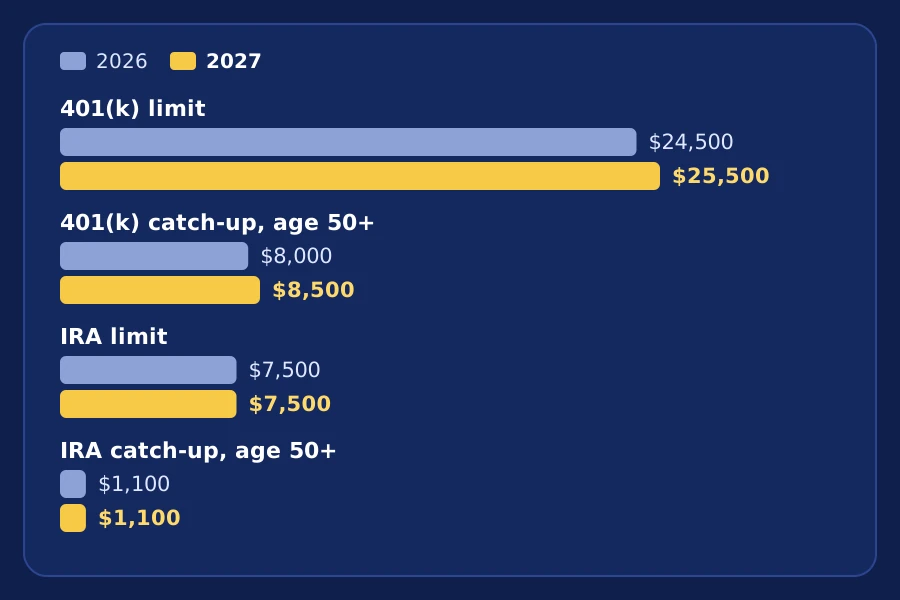
The IRS published the full list of cost-of-living changes in Notice 2026-66. If you want every detail, that’s the official source.
What the 2027 401(k) Limit Means Per Paycheck
Numbers like $25,500 sound big. Here’s what it looks like if you wanted to max out the 2027 401(k) limit, split across a year of paychecks.
| How you’re paid | Per paycheck to reach $25,500 | Extra vs. the 2026 limit |
|---|---|---|
| Weekly (52 checks) | $490.38 | $19.23 |
| Every two weeks (26 checks) | $980.77 | $38.46 |
| Twice a month (24 checks) | $1,062.50 | $41.67 |
| Monthly (12 checks) | $2,125.00 | $83.33 |
Our own calculations, for illustration. They don’t include employer contributions, taxes or your plan’s rules.
Now a reality check. On an $80,000 salary (a made-up example), reaching the 2027 401(k) limit would take about 32% of your pay. That’s a lot, and it’s fine if you can’t get there. Most of the value comes from starting, staying consistent and not leaving free money behind.
Think of the 2027 401(k) limit as a ceiling, not a target. A good goal is the highest percentage you can keep up for years without raiding an emergency fund. If you’re not sure how much room you have, start with a monthly spending baseline.
5 Smart Ways to Use the 2027 401(k) Limit
Get your full employer match first
Many employers match part of what you contribute. If yours does, that’s usually the first dollar to chase. Here’s a made-up example: your employer matches 50% of the first 6% of pay. On an $80,000 salary, contributing 6% ($4,800) would earn a $2,400 match. Formulas vary, so check your plan. Employer money generally doesn’t count toward your own deferral limit, but overall plan limits still apply.
Set a percentage, not a dollar amount
If you save a percentage of pay, your contributions grow when your pay does. Many plans also offer an automatic yearly increase. Even if you never reach the 2027 401(k) limit, moving from 6% to 8% is a real step forward.
Add the extra $1,000 in small steps
If you already max out your 401(k), the extra $1,000 in the 2027 401(k) limit works out to about $38.46 more per biweekly paycheck. If you don’t, a bump of $20 to $40 per paycheck is a manageable way to move in the right direction.
Use catch-up contributions if you’re 50 or older
The 2027 401(k) limit is higher for older savers. At 50 and up, you can add $8,500, for up to $34,000 a year. Under a rule from the SECURE 2.0 Act, workers ages 60, 61, 62 and 63 can add $11,750 instead, for up to $37,250. Check that your plan allows catch-up contributions.
Pair your 401(k) with an IRA if you have room
The IRA limit stays at $7,500, and savers 50 and older can add $1,100 for $8,600. Together with a 401(k), that’s up to $33,000 for someone under 50 and up to $42,600 for someone 50 or older. Whether you can deduct IRA contributions, or contribute to a Roth IRA, depends on income (see below).
Where Should the Next Dollar Go?
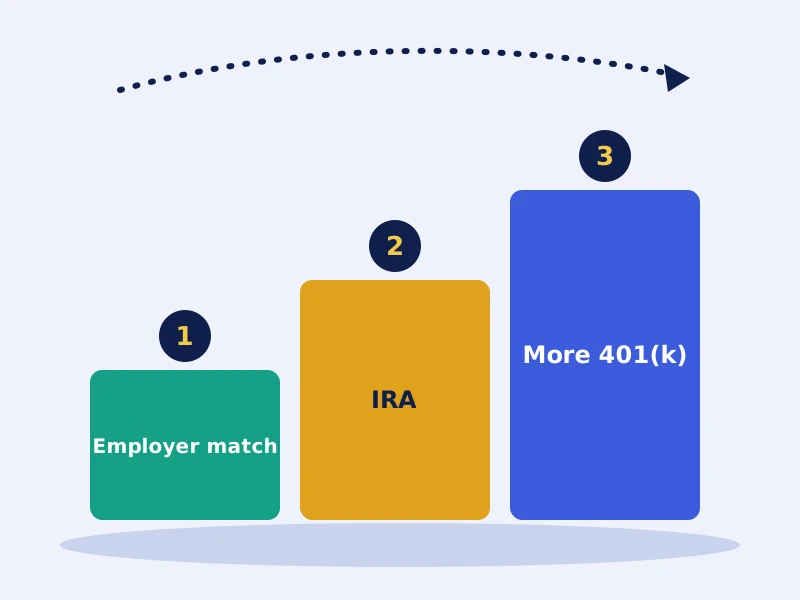
Once you understand the 2027 401(k) limit, the next question is order. Here’s a common approach, and it’s our opinion, not advice:
1. Capture the employer match. 2. Consider an IRA. 3. Go back to your 401(k) and save more toward the limit.
Fees, investment choices, taxes and how soon you may need the money can change the right answer for you.
2027 IRA Income Ranges at a Glance
The IRA limit isn’t changing even though the 2027 401(k) limit is. But the income ranges that decide who can deduct or contribute all went up. Here are the numbers from the IRS notice.
| What it covers | Who | 2027 range | 2026 range |
|---|---|---|---|
| Traditional IRA deduction (covered by a workplace plan) | Single | $83,000 to $93,000 | $81,000 to $91,000 |
| Traditional IRA deduction (contributor covered by a workplace plan) | Married filing jointly | $133,000 to $153,000 | $129,000 to $149,000 |
| Traditional IRA deduction (spouse covered, contributor not) | Married filing jointly | $250,000 to $260,000 | $242,000 to $252,000 |
| Roth IRA contribution | Single or head of household | $158,000 to $173,000 | $153,000 to $168,000 |
| Roth IRA contribution | Married filing jointly | $250,000 to $260,000 | $242,000 to $252,000 |
The Saver’s Credit, which helps lower- and moderate-income workers, also rose. The 2027 income limits are $83,000 for married couples filing jointly, $62,250 for heads of household, and $41,500 for singles and married people filing separately.
A higher 2027 401(k) limit is not a reason to empty your emergency fund. Money in a 401(k) is meant for retirement, and early withdrawals can bring taxes and penalties. Keep some cash outside the plan first.
Common Mistakes With the 2027 401(k) Limit
- Missing the match. Leaving employer money on the table is the costliest mistake on this list.
- Forgetting to update your election. If you set a dollar amount, it won’t rise on its own. Check your contribution settings before January.
- Counting only one plan. The 401(k) limit generally applies to your total deferrals across plans. If you changed jobs, add up what you put in at each one.
- Mixing up limits. The 2027 401(k) limit is what you can defer from your pay. It isn’t the same as the total that can go into your account, which includes employer money.
- Ignoring fees and investments. A bigger contribution matters less if your money sits in a costly or poorly matched fund.
Bottom Line
The 2027 401(k) limit rises to $25,500, catch-ups are up to $8,500 (or $11,750 for ages 60 to 63), and the IRA limit stays at $7,500. You don’t have to max out anything to win. Check your contribution percentage this month, capture your full match, and add a small bump if you can.
Thinking about retiring somewhere new? Our guide to retirement visa routes explains what living abroad can involve.
Information is current as of Nov. 24, 2026 and is based on the IRS announcement of Nov. 12, 2026. Plan rules vary, and your tax situation is personal. This is general information, not tax or financial advice. Confirm details with your plan administrator or a qualified professional.