

Most small businesses can’t just call an investment bank and go public. The costs are high, the rules are strict, and the usual path is built for much larger companies. That’s where Regulation A+ comes in. It’s a federal exemption that lets a smaller US company sell shares to the public, sometimes called a “mini IPO.”
This guide explains how Regulation A+ works, what the Nasdaq listing rules look like for small companies in 2026, what it can cost, and where the risks are. It’s general information, not legal advice, and a securities attorney should review any real plan.
Regulation A+ at a glance (as of Nov. 26, 2026)
Sources: SEC Regulation A guidance and Nasdaq Listing Rules 5500 series.
What Is Regulation A+?
Regulation A+ is the popular name for Regulation A after Congress expanded it under the JOBS Act. It lets a company raise money from the public without going through the full registration process used for a traditional IPO. The SEC still reviews the paperwork, and the company must “qualify” its offering before it can take any money.
The offering comes in two tiers. Under the SEC’s current rules, Tier 1 is capped at $20 million and Tier 2 at $75 million in a 12-month period. Here are the terms you’ll see most often.
Tier 1
Up to $20 million. Financial statements don’t have to be audited. State securities regulators can also review the offering.
Tier 2
Up to $75 million. Audited financials are required, and the company must file ongoing reports. State review isn’t required.
Form 1-A
The offering statement filed on the SEC’s EDGAR system. It includes the offering circular that investors read.
Qualification
The SEC’s go-ahead to start selling. It is not an approval of the business or the investment.
Regulation A+ vs. Other Ways to Raise Capital
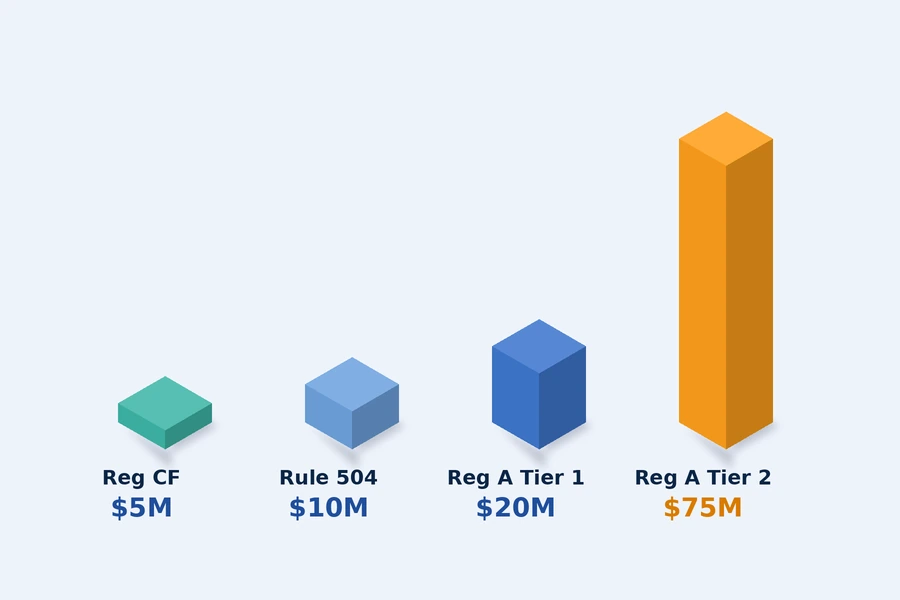
Regulation A+ isn’t the only exempt offering. Here’s how it compares with two other common options, based on the SEC’s exempt offerings chart.
| Option | 12-month limit | Key points |
|---|---|---|
| Regulation Crowdfunding | $5 million | Not available to non-US companies. Filed on Form C. |
| Rule 504 of Regulation D | $10 million | Filed on Form D. Not open to companies that already report to the SEC. |
| Regulation A+ Tier 1 | $20 million | No investor limits. Financials need not be audited. State review applies. |
| Regulation A+ Tier 2 | $75 million | Audited financials and ongoing reports. Non-accredited investors face limits unless the shares will be exchange-listed. |
What Is a Mini IPO?
“Mini IPO” is an informal label, not a legal term. It usually means a Regulation A+ Tier 2 offering to the general public, where the company may then ask to list its shares on an exchange like Nasdaq. A traditional IPO works differently. It uses a full registration statement and, for most companies, a big underwriter.
Two points matter most. First, SEC qualification doesn’t mean the SEC has judged the accuracy or merits of the offering. Second, a Regulation A+ offering doesn’t guarantee a stock exchange listing. The company still has to meet the exchange’s own rules.
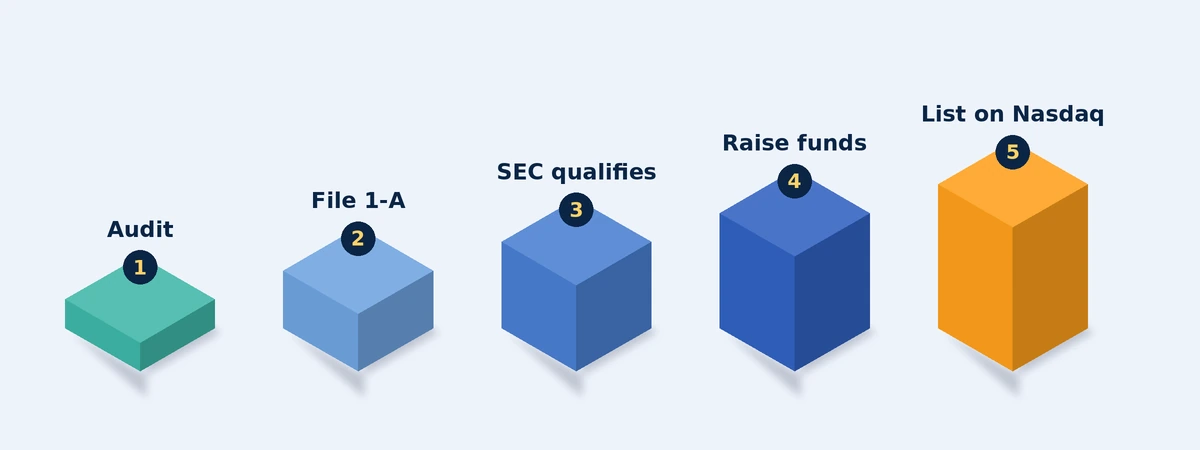
7 Steps to a Regulation A+ Mini IPO
Every deal is different, but most Regulation A+ offerings follow this path.
Confirm you’re eligible
Regulation A+ is open to US and Canadian companies. Certain types of companies, such as blank check companies and investment companies, are excluded, and “bad actor” rules can disqualify an issuer. An attorney can check this first.
Get audited financials
Tier 2 offerings need two years of audited financial statements. The audit often takes the longest, so many companies start here.
Pick a tier
Tier 1 is capped at $20 million and may bring state-by-state review. Tier 2 allows up to $75 million, requires ongoing reports and avoids state review, so many larger raises choose it.
File Form 1-A and get qualified
You file the offering statement on EDGAR. The SEC charges no filing fee, according to its Regulation A guide. You can’t accept payment until the SEC qualifies the offering.
Raise the money
You sell shares to investors, often with help from broker-dealers or online platforms. One law firm estimates a Regulation A+ offering takes about four to six months from start to finish.
Apply to list, if you want to
Listing on Nasdaq is optional. If you go for it, you’ll need to meet the exchange’s rules (see the next section).
Keep reporting
Tier 2 companies file annual reports (Form 1-K), semiannual reports (Form 1-SA) and current reports (Form 1-U). Tier 1 companies mainly file a final exit report.
Nasdaq Listing Requirements for Small Companies in 2026
A company that wants to list through a Regulation A+ offering usually aims for the Nasdaq Capital Market, which has the lowest bar of Nasdaq’s three tiers. The rules changed several times this year, so check Nasdaq’s rulebook before you plan. Here are the main requirements.
| Requirement | Nasdaq Capital Market |
|---|---|
| Minimum share price | $4. The single $4 minimum was set to take effect Oct. 30, 2026. |
| Unrestricted publicly held shares | At least 1,000,000 |
| Round lot holders | At least 300, and at least half must hold $2,500 or more in unrestricted shares |
| Market makers | At least 3 registered and active |
| Public float (IPO listings) | At least $15 million in unrestricted publicly held shares, met from the offering proceeds |
| Financial test (pick one) | Equity standard ($5 million equity and a two-year operating history), market value standard ($50 million market value of listed securities and $4 million equity) or a profit-based net income standard |
As of Nov. 26, 2026. Rules change. See Nasdaq’s 5500 series for the current text.
For many small companies, the hard part isn’t the SEC paperwork. It’s the numbers. To list on Nasdaq through a Regulation A+ offering, you may need to raise at least $15 million, sell shares at $4 or more, and end up with hundreds of shareholders. If your business can’t reach that, a smaller raise without a listing may be more realistic.
What Does Regulation A+ Cost?
Costs vary a lot, and good public numbers are hard to find. Most published estimates come from firms that sell Regulation A+ services, so treat them as rough, self-reported figures. One such firm says legal fees for the filing start around $75,000 and total costs run roughly 10% of the capital raised, including broker and transfer agent fees.
Here’s a quick example using that 10% estimate. It’s an illustration, not a quote.
| Capital raised | Estimated all-in cost (about 10%) | Left for the business |
|---|---|---|
| $5,000,000 | $500,000 | $4,500,000 |
| $15,000,000 | $1,500,000 | $13,500,000 |
| $30,000,000 | $3,000,000 | $27,000,000 |
Our own calculations based on a vendor estimate. These don’t include ongoing audit, legal, exchange and reporting costs after the offering.
Selling shares means giving up part of your company and some control. Public reporting takes time and money. A stock price can swing, and an exchange can delist a company that falls below its standards. Investors should also know that fraudsters have described SEC qualification as an official approval to mislead people. It isn’t one.
Is Regulation A+ Right for Your Business?
It can make sense if most of these are true:
- You need several million dollars, not just a few hundred thousand.
- You have audited financials, or the time and money to get them.
- You can handle public reporting and answer to shareholders.
- You already have customers or fans who might buy your shares.
- You’ve talked with a securities attorney and an experienced auditor.
If those don’t fit yet, start by getting your own numbers in order. A monthly spending baseline is a simple first step, and smaller options like Regulation Crowdfunding or Rule 504 may be a better match.
What Could Change: 2026 SEC Proposals
The SEC is working on rules to make it easier for smaller companies to go public and stay public. In May 2026, it proposed changes that would let companies file semiannual instead of quarterly reports and expand shelf registration. The SEC has also said it will consider updates to Regulation A on its 2026 agenda. These are proposals, not final rules, so today’s limits and requirements still apply.
Bottom Line
Regulation A+ gives small US businesses a path to raise up to $75 million from the public, and some use it to reach Nasdaq. It’s cheaper and simpler than a traditional IPO, but it’s still expensive, slow and full of rules. Know the limits, run the numbers, and get professional advice before you file anything.
Information is current as of Nov. 26, 2026, based on SEC and Nasdaq sources and public law firm commentary. Cost figures are vendor estimates. This is general information, not legal, tax or investment advice. Talk with a qualified securities attorney before raising capital.