


Finding the right funding can make a major difference to a small business. Whether you’re opening a local store, buying equipment, hiring employees, developing new technology, or expanding into another market, there are several ways to finance your next step. The challenge is knowing which programs are real, which ones your business can qualify for, and whether a grant or a loan makes more sense.
This guide to small business grants and loans explains more than 15 funding routes available to eligible U.S. businesses in 2026. It covers federal loan programs, targeted grants, research funding, state and local support, community lenders, application requirements, and common funding scams.
Grants vs. Loans: What’s the Difference?
Before searching for small business grants and loans, understand how the two types of funding work. A grant is an award for an approved purpose. A loan is borrowed money that must be repaid.
| Feature | Grant | Business Loan |
|---|---|---|
| Repayment | Usually no repayment if award conditions are met | Repayment is required |
| Competition | Often competitive, with limited funding | Approval depends on lender and borrower qualifications |
| Use of money | Restricted to the approved project or purpose | Depends on the loan agreement |
| Financial review | May require budgets, reports, and project outcomes | Usually includes credit and repayment assessment |
| Best suited for | Eligible projects that match a grant’s goals | Businesses with a clear financing need and repayment plan |
A grant is not automatically the better choice. A business may spend months preparing a competitive grant application without receiving an award. A loan may be more practical when the company needs funding on a predictable schedule and can afford the payments.
15+ Small Business Funding Programs and Options
The following options include federal loan programs, targeted grant opportunities, state-level assistance, and community financing. They are not all grants, and they do not share one application process. Eligibility, availability, deadlines, and funding amounts depend on each program.
1. SBA 7(a) Loan Program
The SBA 7(a) program is the agency’s primary business loan program. It helps eligible small businesses obtain financing through participating lenders. The maximum loan amount is generally $5 million.
Eligible uses can include working capital, equipment, real estate, business acquisition, and certain debt refinancing. Businesses must meet SBA requirements, operate for profit in the United States, and demonstrate a reasonable ability to repay.
2. SBA 504 Loan Program
The 504 program provides long-term, fixed-rate financing for major fixed assets through Certified Development Companies (CDCs). It may suit a business purchasing commercial property, constructing a facility, or acquiring eligible long-term equipment.
It is not a general working-capital loan. Inventory and ordinary operating expenses are not eligible uses. Loan structure and limits depend on the project and applicable rules.
3. SBA Microloan Program
SBA Microloans are available in amounts of up to $50,000. They are provided through nonprofit intermediary lenders rather than directly by the SBA.
They may help eligible small businesses pay for working capital, inventory, supplies, furniture, fixtures, and equipment. Each intermediary sets its own application process and evaluates borrowers.
4. SBA 7(a) Working Capital Pilot
The Working Capital Pilot is designed for eligible businesses that need a monitored line of credit. It may be useful for manufacturers, wholesalers, professional service firms, and companies fulfilling larger orders or contracts.
Businesses generally need at least one year of operating history and reliable financial reporting. The program is not a substitute for a grant: borrowed amounts must be repaid under the lender’s agreement.
5. SBA Export Loan Programs
Small businesses that sell products or services internationally may need financing for production, supplier payments, export orders, or working capital. SBA-backed export financing options are designed to help qualifying U.S. exporters access funding.
Eligibility and terms vary by program and lender. Exporters should review the current options and speak with an SBA export finance specialist before choosing a product.
6. SBIR – Small Business Innovation Research
America’s Seed Fund, powered by the SBIR program, supports eligible U.S. small businesses developing innovative technologies that address federal research and development needs.
Funding opportunities are issued by participating federal agencies. A business must match its technology proposal to an active agency topic and meet the program’s ownership, size, and other eligibility rules.
7. STTR – Small Business Technology Transfer
The STTR program also supports research and development, but it requires a formal partnership between an eligible small business and a nonprofit research institution, such as a university or federal research center.
This can be relevant to technology companies working on advanced materials, healthcare, engineering, software, and other research-intensive projects.
8. USDA Rural Business Development Grants
The USDA Rural Business Development Grant program supports eligible rural business and community development activities. However, it is important to understand who can apply: eligible applicants include public bodies, federally recognized tribes, and qualifying nonprofit entities serving rural areas.
For-profit businesses and individuals cannot apply directly for this grant. The USDA’s published 2026 application window is closed, so applicants should check the official page for future announcements.
9. State Trade Expansion Program (STEP)
STEP supports eligible small-business export development through state and territory partners. Depending on the local program, assistance may help qualifying companies with approved international trade activities.
It is not one universal federal grant application for every company. Contact the state agency administering STEP to check current funding, eligible expenses, reimbursement rules, and deadlines.
10. SBA Manufacturing Assistance
The SBA lists manufacturing-related grant initiatives, including support for training and workforce development through eligible organizations and partners. These opportunities should not be confused with an unrestricted cash grant available to every manufacturer.
Manufacturers should check the current program description to identify whether the applicant is a business, nonprofit, educational institution, or intermediary organization.
11. State Small Business Grants
State economic development agencies sometimes offer targeted grants, incentives, or reimbursement programs for activities such as hiring, equipment investment, innovation, energy improvements, or expansion.
Programs vary widely. A business in Texas may find different opportunities from a company in New York or California. Check your state’s official economic development website for open applications.
12. City and County Business Incentives
Local governments may offer small-business assistance, façade improvement grants, redevelopment incentives, workforce support, or help with commercial district projects.
These programs are often tied to a specific location, neighborhood, industry, or public development goal. Contact your city or county economic development office to find out what is currently available.
13. Community Development Financial Institutions (CDFIs)
CDFIs are mission-driven financial institutions that provide financing and support to communities and businesses that may face barriers to traditional credit. Some offer small-business loans, technical assistance, or specialised lending.
They are lenders, not automatically grant providers. Compare interest rates, fees, repayment schedules, and eligibility before accepting an offer.
14. Nonprofit Microfinance Organizations
Some nonprofit lenders provide smaller loans, business coaching, and financial education to entrepreneurs. Their target borrowers, loan sizes, locations, and eligibility rules vary.
Ask whether the organization lends directly, refers applicants to another lender, or only provides training. Review the full repayment terms before signing.
15. SBA 8(a) Business Development Program
The 8(a) program is designed to help eligible socially and economically disadvantaged small businesses compete in the federal marketplace. It can provide business development support and access to certain federal contracting opportunities.
It is not a general cash grant or automatic loan. Businesses must satisfy the program’s eligibility and certification requirements.
16. Small Business Development Centers (SBDCs)
SBDCs provide business counseling and support to entrepreneurs and small companies. They can help owners prepare business plans, understand financing options, and improve their readiness to approach lenders.
An SBDC is not itself a grant or loan. Its value is practical guidance that may help you prepare a stronger funding application.
17. SCORE Mentoring
SCORE connects entrepreneurs with volunteer business mentors and educational resources. A mentor may help you review your business plan, prepare financial projections, or think through a funding strategy.
SCORE does not award government grants or approve SBA loans. It can help you become better prepared to approach the organizations that do.
How to Find the Right Grant or Loan
Searching for small business grants and loans without a clear plan can waste time. Start with the amount you need, what you will spend it on, and how quickly you need the money.
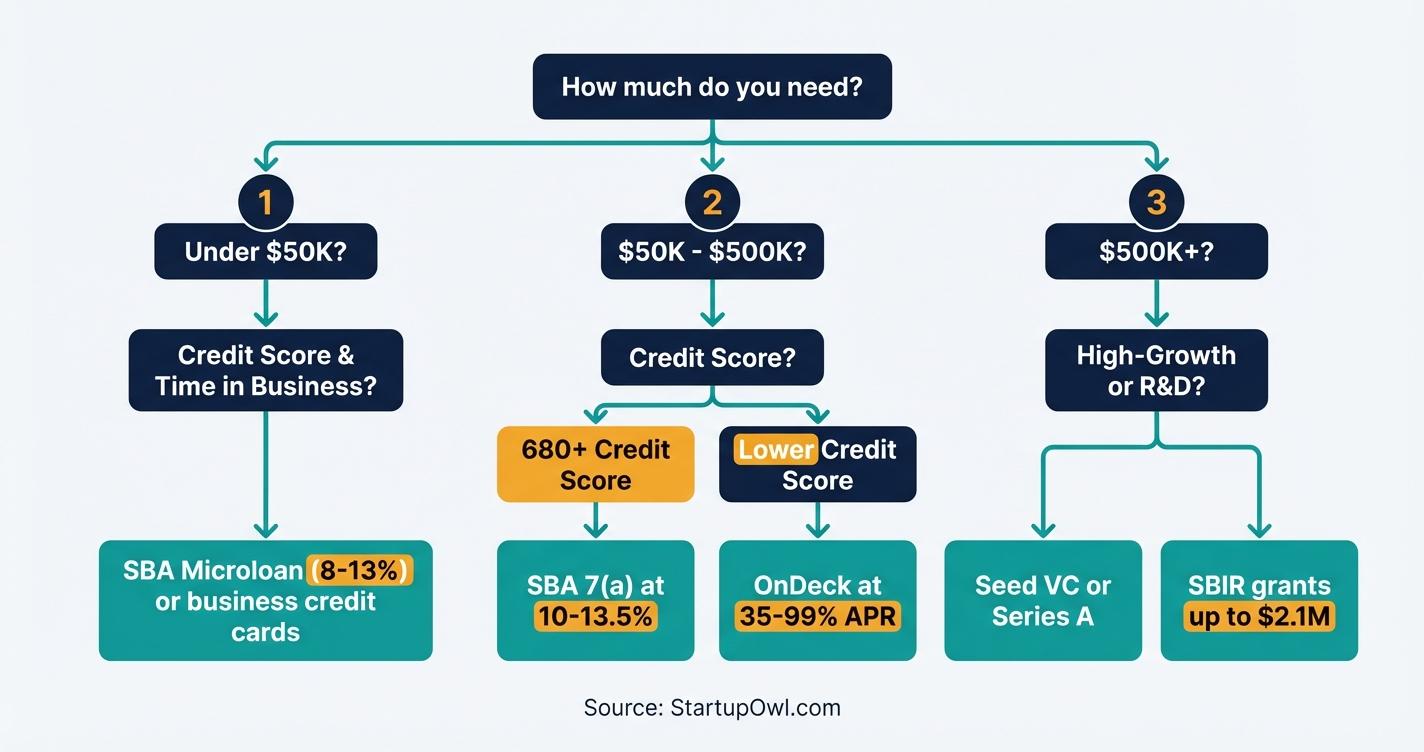
A funding decision flowchart can help you narrow your options. The rates and figures shown in this illustration are examples, not current lender offers or guaranteed terms. Verify all figures directly with the provider.
Step 1: Define the purpose
Write down exactly what the money will pay for. Equipment, inventory, payroll, research, property, and export development may qualify under different programs.
Step 2: Calculate the funding amount
Prepare a realistic budget. Include the purchase price, installation, operating costs, taxes, and a reasonable cash reserve. Avoid borrowing more than the business can support.
Step 3: Check eligibility before applying
Review location, business size, industry, ownership, operating history, project purpose, and any matching-fund requirement. A program’s eligibility rules are more important than its headline funding amount.
Step 4: Compare the full cost of borrowing
For loans, compare the annual percentage rate (APR), interest rate, origination fees, collateral requirements, personal guarantees, repayment period, and early-payment conditions. A lower monthly payment may still mean a higher total borrowing cost.
Step 5: Apply through the official provider
Use the official government portal, participating lender, state agency, or named program administrator. Do not pay an unknown intermediary who promises guaranteed approval.
Documents You May Need
Requirements differ, but lenders and grant administrators commonly request some of the following documents:
- Business plan and description of the project.
- Business registration and ownership information.
- Employer Identification Number (EIN), where applicable.
- Recent business tax returns and financial statements.
- Profit-and-loss statement and balance sheet.
- Cash-flow forecast and funding budget.
- Bank statements and existing debt information.
- Equipment quotes, contractor estimates, or project proposals.
- Personal financial information or credit authorisation, where required.
- Grant-specific forms, certifications, and supporting evidence.
Do not assume every program needs every document. Follow the checklist in the official application notice or lender instructions.
How to Apply for Federal Grants
For federal grant opportunities, Grants.gov is the central portal for finding and applying for many government funding announcements. The application process generally involves these steps:
- Search for a suitable opportunity: Use keywords and filters to find a grant that matches your project and organisation type.
- Read the full notice: Check eligible applicants, project activities, deadlines, award conditions, and required attachments.
- Confirm registration requirements: Organisation applicants may need registrations and identifiers before submitting an application.
- Prepare the proposal: Explain the problem, proposed work, budget, expected outcomes, and ability to deliver the project.
- Submit through the required system: Follow the official instructions and retain your tracking information.
Read Grants.gov eligibility guidance and the official grant application steps.
How to Avoid Small Business Funding Scams
Funding searches attract scammers because business owners may be under pressure to find money quickly. Be cautious if someone contacts you with an offer that sounds unusually easy.
- Guaranteed approval: Legitimate grant and loan providers do not guarantee approval before reviewing eligibility.
- Upfront release fees: Be suspicious of demands for payment to unlock a supposed government grant.
- Unofficial email addresses: Verify that messages come from the organisation’s real domain.
- Pressure to act immediately: Do not send money or sensitive documents because someone claims an offer expires in a few hours.
- Requests for passwords: Never share banking passwords, one-time codes, or account login details with a funding agent.
- Fake government branding: Confirm the programme on the official agency website instead of trusting a logo in an advertisement.
Start with official resources such as SBA.gov and Grants.gov. If an offer cannot be verified, do not proceed until you have contacted the agency using independently confirmed contact details.
Which Funding Option Should Your Business Consider?
| Your business need | Possible starting point | What to check |
|---|---|---|
| Working capital or general expansion | SBA 7(a), CDFI or bank financing | Cash flow, credit, repayment ability |
| Commercial property or major equipment | SBA 504 | Eligible fixed assets and project structure |
| Small funding requirement | SBA Microloan or nonprofit lender | Intermediary terms and permitted uses |
| Technology research and development | SBIR or STTR | Agency topic, research fit and eligibility |
| Export expansion | SBA export financing or STEP support | Export activity and state-specific rules |
| Rural community development | USDA Rural Business Development Grant | Eligible applicant type and rural project rules |
| Local property or hiring project | State, city or county incentives | Location, job creation and investment conditions |
There is no single best option for every company. A startup with no revenue may face different lending requirements from an established manufacturer with contracts and a track record. Match the funding route to the business’s actual position rather than applying everywhere.
Frequently Asked Questions
Can I get a free government grant to start a small business?
There is no general federal grant that gives every entrepreneur free money to start an ordinary for-profit business. Some targeted grants support research, exporting, manufacturing, or specific public and community goals. Always check the programme’s official eligibility rules.
Does the SBA give grants directly to small businesses?
The SBA offers limited grant opportunities for specific purposes, including research, manufacturing support, exporting, and entrepreneurship support through eligible organisations. It does not provide general grants to start or expand an ordinary small business.
What is the maximum SBA 7(a) loan?
The standard maximum for an SBA 7(a) loan is $5 million. Approval, loan structure, interest rate, fees, and repayment terms depend on the borrower, lender, and applicable SBA rules.
Can a new business apply for an SBA loan?
Some startups may qualify, but approval is not automatic. Lenders assess the business plan, owner experience, creditworthiness, proposed use of funds, and ability to repay.
Are SBA Microloans grants?
No. SBA Microloans are loans of up to $50,000 provided through intermediary lenders. Borrowers must repay the amount under the agreed terms.
Where can I search for federal small business grants?
Start with Grants.gov and review the eligibility rules in each opportunity notice. You can also check the relevant agency’s official website for programme-specific information.
Final Thoughts
Finding suitable small business grants and loans takes research, preparation, and a realistic understanding of what your company needs. Grants can be valuable when your project matches a specific funding objective, but they are competitive and often restricted. Loans can offer a more direct route to capital, but they create a repayment obligation.
Start by defining your project, checking your eligibility, and comparing the total cost of financing. Use official government websites and reputable lenders, prepare your financial documents carefully, and avoid anyone promising guaranteed funding.
The strongest funding decision is not necessarily the one with the largest headline amount. It is the one your business qualifies for, can use responsibly, and can manage over the long term.
Helpful Official Resources
- U.S. Small Business Administration – Loan Programs
- SBA – Grant Opportunities
- Grants.gov – Federal Funding Opportunities
- Grants.gov – Grant Eligibility
- America’s Seed Fund – SBIR/STTR
- USDA – Rural Business Development Grants
- U.S. Treasury – CDFI Fund
Program information checked on November 25, 2026. Funding availability, eligibility, deadlines, loan terms, and agency rules can change. Confirm current details with the official programme administrator before applying.
Related reading: Explore our guide to 15 Best Business Tools for Small Businesses in 2026 to learn about software that can help organise business finances and daily operations.