
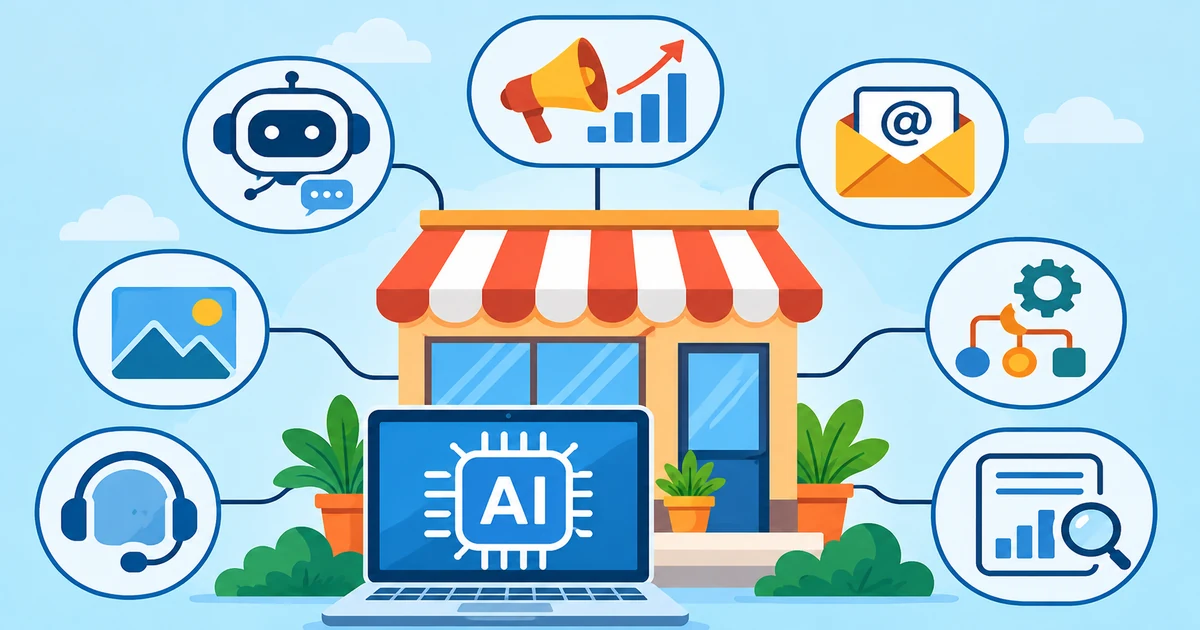
Artificial intelligence is creating a new business opportunity: helping small companies use AI without having to build their own technology teams. From customer-service chatbots to marketing automation, businesses need practical solutions that save time, improve customer experiences, and make everyday work easier.
You do not need to develop a new AI model or build complicated software to enter this market. You can learn existing platforms, understand a business problem, and offer a clearly defined service that helps solve it.
Why AI Services for Small Businesses Are a Growing Opportunity
AI adoption among U.S. businesses is increasing, although survey results vary depending on the businesses surveyed and how AI use is defined.
The U.S. Chamber of Commerce’s 2026 Empowering Small Business report found that 66% of surveyed U.S. small businesses were using AI, compared with 58% in 2025.
Separately, the Federal Reserve’s 2026 Report on Employer Firms found that 46% of employer firms reported current AI use. Among firms using AI, common applications included writing and marketing, productivity, planning, and analysis.
These figures come from different surveys and should not be treated as directly comparable. However, both point to growing business interest in AI.
There is also a practical gap between trying an AI tool and integrating it into daily operations. Some businesses need help selecting tools, connecting systems, checking outputs, training employees, or building repeatable processes.
7 AI Services You Can Sell to Small Businesses in 2027
1. AI Chatbot Setup for Websites and Customer Support
Many small businesses receive similar questions every day: What are your opening hours? How much does a service cost? Do you deliver to this location? How can I book an appointment?
You can help businesses set up an AI chatbot that answers approved questions, directs visitors to relevant pages, collects basic lead information, and sends complicated requests to a human employee.
Potential customers
- Local service businesses and repair companies
- Online stores and e-commerce brands
- Real estate agencies
- Hotels, travel businesses, and appointment-based services
Tools to explore
Chatbase, Tidio, Manychat, and OpenAI API.
What you can deliver
- A chatbot configured around approved business information
- A set of frequently asked questions and answers
- Lead collection and human handoff settings
- Testing, documentation, and basic staff training
How to make money: Charge for initial setup and, if the client wants ongoing help, offer a separate maintenance plan. Define limits for updates, support, usage, and integrations before agreeing on a fee.
2. AI-Powered Social Media Content Services
Small businesses often struggle to publish consistently on platforms such as Instagram, Facebook, LinkedIn, and TikTok. You can help them plan and produce content using AI-assisted research, writing, design, and video-editing tools.
Your service can include a monthly content calendar, post captions, creative concepts, short-form video scripts, basic graphics, and a review-ready publishing schedule.
Tools to explore
What you can deliver
- A 30-day content plan
- Post captions and creative briefs
- Branded graphics and short-video drafts
- A monthly performance summary
How to make money: Offer a fixed monthly package based on the number of posts, videos, revisions, and platforms. Keep publishing approval with the client unless you have explicitly agreed to manage the account.
Important: AI-generated content still needs fact-checking, brand review, and appropriate image or music rights checks.
3. AI Email Marketing and Newsletter Services
Email remains a useful way for businesses to communicate with customers, announce offers, share updates, and encourage repeat purchases. AI can help with drafting, subject-line ideas, segmentation suggestions, and campaign planning.
You can help a small company create welcome emails, promotional newsletters, customer follow-ups, and simple automated sequences.
Tools to explore
Mailchimp, Brevo, and HubSpot Email Marketing.
What you can deliver
- A welcome email sequence
- A monthly newsletter calendar
- Campaign copy and design
- Basic audience segmentation and reporting
How to make money: Charge per campaign or offer a monthly service covering a defined number of emails and reports.
Important: Use permission-based contact lists and follow applicable email marketing and privacy rules. Do not upload a client’s customer list to an AI service without checking its data-processing terms and obtaining the required authorization.
4. AI Workflow Automation for Repetitive Tasks
Small businesses often repeat the same administrative tasks: transferring form submissions into spreadsheets, sending appointment reminders, notifying staff about new leads, or preparing routine reports.
You can map these processes and connect compatible apps so that routine steps happen automatically. The value is not the automation itself; it is reducing avoidable manual work while keeping people in control of important decisions.
Tools to explore
Example workflow
- A potential customer submits a website form.
- The details are added to the client’s approved CRM or spreadsheet.
- The sales team receives a notification.
- The customer receives an approved acknowledgement email.
- A staff member reviews the lead and decides the next action.
What you can deliver: A documented workflow, connected applications, error notifications, testing, and a simple handover guide.
How to make money: Charge by project scope and complexity. Offer ongoing monitoring separately if the client needs it.
5. AI Customer Support and Helpdesk Setup
A chatbot answers common questions, but a complete customer-support workflow can do more. It can organize incoming requests, suggest responses, summarize conversations, classify support tickets, and route issues to the right employee.
You can help a business configure a helpdesk system and create a consistent process for handling customer requests.
Tools to explore
Intercom, Zendesk, and Freshdesk.
What you can deliver
- Support categories and ticket-routing rules
- Approved response templates
- Knowledge-base organization
- AI-assisted summaries and draft replies
- Escalation rules for sensitive or complicated cases
How to make money: Offer a one-time setup project followed by optional monthly optimization and reporting.
6. AI Product Photography and Marketing Visuals
Online sellers and local businesses need attractive product images, promotional graphics, and advertising creatives. AI-assisted image tools can help create backgrounds, remove distractions, develop concepts, and prepare visual variations.
You can offer image editing and creative production while ensuring that the final image accurately represents the real product.
Tools to explore
Adobe Firefly, Canva, and Midjourney.
Potential customers
- Small e-commerce stores
- Local retailers
- Food and beverage brands
- Home décor and lifestyle businesses
What you can deliver: Product-background edits, promotional graphics, ad creative variations, and social media image sets.
How to make money: Charge per approved image set or offer a monthly creative package. Agree on image dimensions, revision limits, usage rights, and delivery formats in advance.
Important: Do not use AI to change a product’s important features, materials, size, color, or performance in a way that could mislead buyers.
7. AI Research and Business Reporting
Business owners need useful information to make decisions, but collecting and organizing it can take time. AI can assist with summarizing public information, organizing feedback, preparing first drafts of reports, and explaining trends in business data.
You can offer research support and reporting services for businesses that need clearer information but do not have a dedicated analyst.
Tools to explore
ChatGPT, Perplexity, and Notion.
What you can deliver
- Competitor research based on public sources
- Customer-feedback summaries
- Market research briefs
- Monthly performance summaries
- Organized research with source links
How to make money: Charge for a defined research report or recurring reporting package. Clearly state the research period, sources, limitations, and questions the report covers.
Important: Verify figures and claims against original sources. AI-generated summaries can contain errors, and business reports should never present unverified assumptions as facts.
Which AI Service Should You Start With?
You do not need to offer all seven services immediately. Starting with one or two services makes it easier to learn the tools, build examples, understand client needs, and deliver consistent results.
| Your strength or interest | Service to consider | What to learn first |
|---|---|---|
| Writing and communication | Social media and email marketing | Content planning, editing, audience research |
| Organizing tasks and systems | Workflow automation | Triggers, actions, integrations, testing |
| Customer interaction | Chatbot and support setup | Knowledge bases, conversation flows, escalation |
| Visual creativity | Product visuals | Image editing, brand consistency, usage rights |
| Research and analysis | Business reporting | Source checking, spreadsheets, clear summaries |
How to Start an AI Services Business: A Practical Roadmap
- Choose one customer type. Start with a business category you understand, such as local retailers, real estate agencies, restaurants, online stores, or professional service providers.
- Identify one expensive or repetitive problem. Speak with business owners and find out what takes too much time, creates delays, or causes missed customer opportunities.
- Learn the tools needed for that problem. Do not buy multiple subscriptions immediately. Start with free plans or trials where available and check their commercial-use terms.
- Build a demonstration. Create a sample chatbot, a sample content calendar, or a working automation using dummy data. Do not use real customer information without permission.
- Create a clear service package. Explain exactly what the client receives, what is excluded, how many revisions are included, and who pays for third-party software.
- Find your first clients. Use professional networking, local business groups, LinkedIn, referrals, and carefully targeted outreach. Show a relevant demonstration instead of sending generic sales messages.
- Measure the result. Track useful outcomes such as response time, completed tasks, content delivery, or fewer manual steps. Ask for permission before using a client’s results as a case study.
How Much Should You Charge for AI Services?
There is no single standard price for these services. The right fee depends on the client’s requirements, software costs, setup complexity, integrations, support expectations, and the value of the work delivered.
Instead of copying an online price list, use a simple pricing structure:
| Pricing model | Best suited for | Example of what it covers |
|---|---|---|
| One-time project fee | Initial setup work | Chatbot configuration, email sequence, automation setup |
| Monthly retainer | Ongoing services | Content production, support optimization, reporting |
| Per-deliverable fee | Clearly defined outputs | Approved product images, research reports, campaign drafts |
| Training fee | Team enablement | Staff training, documentation, workflow handover |
How to Find Small Business Clients in the United States
You do not need to target every business in the country. A focused service and a clear customer profile can make outreach more effective.
- Local business directories: Research businesses whose websites or customer processes show a specific problem you can help solve.
- LinkedIn: Connect with owners, operators, marketing managers, and agency professionals. Share useful demonstrations and practical insights.
- Business communities: Participate in relevant industry groups and answer questions before offering a service.
- Agency partnerships: Contact web-design, marketing, and IT agencies that may need help delivering AI-related projects.
- Your own website: Publish service pages, demonstrations, case studies, and clear contact information.
A useful first message should be specific. For example, explain that you noticed a business has no clear after-hours inquiry process and offer to demonstrate a simple chatbot that answers approved questions and directs complex requests to staff.
Avoid sending mass messages that promise guaranteed sales, instant growth, or unrealistic savings. Focus on a problem you can actually solve.
Important Risks and Responsibilities
AI services involve access to business information, customer conversations, brand assets, and sometimes personal data. Treat these responsibilities as part of your service—not as optional extras.
- Protect customer data: Get permission before using client information in third-party AI tools and review the provider’s privacy and data-retention terms.
- Check AI outputs: Review facts, calculations, names, links, and recommendations before delivering work.
- Respect intellectual property: Confirm that images, music, fonts, and other assets can be used for the intended commercial purpose.
- Set clear boundaries: Document what the AI system can do and when a human must take over.
- Be transparent: Do not claim that work is fully automated, human-reviewed, or independently tested unless that is true.
- Check applicable rules: Privacy, advertising, accessibility, and industry-specific requirements may apply depending on the client and service.
Frequently Asked Questions
1. Can beginners sell AI services to small businesses?
Yes, if they learn a specific tool, understand a real business problem, and can demonstrate a reliable solution. Start with a narrow service and build experience before accepting complex projects.
2. Do I need coding skills to start an AI services business?
Not for every service. Content planning, email campaign support, visual editing, and many no-code chatbot or automation projects can be started with limited coding. More advanced integrations may require technical skills.
3. Which AI service is easiest to start with?
It depends on your existing skills. Content planning may suit strong writers, visual production may suit creative people, and simple workflow automation may suit people who enjoy organizing processes.
4. Can I sell AI services to U.S. clients while living in another country?
Many digital services can be delivered remotely, but you must consider client contracts, payment methods, taxes, data protection, time zones, and any legal or regulatory requirements that apply to your situation.
5. Should I sell AI tools or AI services?
Beginners can often start by implementing existing tools for a defined business need. Selling software products involves a different set of responsibilities, including product development, support, security, and ongoing maintenance.
6. How can I build trust with my first client?
Show a working demonstration, explain limitations, agree on deliverables in writing, protect the client’s information, and provide a clear handover. Never promise results you cannot control.
Final Thoughts
AI is opening new opportunities for people who can connect technology with everyday business needs. Small businesses do not necessarily need another complicated platform; many need practical help with customer communication, marketing, repetitive tasks, and better use of information.
Choose one service, learn the tools, build a demonstration, and speak with businesses that could genuinely benefit. Improve your process with every project and expand only when you can deliver reliable results.
The strongest AI services business will not be the one using the most tools. It will be the one that solves real problems, protects customer trust, and delivers measurable value.
Continue Learning on TechAndWealth
- 15 AI Side Hustles That Could Make Money in 2027 — explore more ways to build income using AI.
- AI Automation Skills in 2027: How to Learn and Make Money — learn the skills behind practical automation projects.
- 15 Best Business Tools for Small Businesses in 2026 — explore software that can support business operations.
- Robofy Review: Is This AI Chatbot Worth It in 2027? — learn more about an AI chatbot option.
Research and Further Reading
- U.S. Chamber of Commerce — 2026 Empowering Small Business Report
- Federal Reserve Banks — 2026 Report on Employer Firms
- Federal Reserve Bank of San Francisco — AI Adoption Among Small Businesses
Research note: The adoption figures cited above come from separate surveys with different samples and definitions. They should not be compared as if they measured exactly the same population.
Disclaimer: This article is for general educational and informational purposes. It is not legal, tax, financial, or professional business advice. Tool features, availability, and pricing can change; confirm current terms directly with each provider.